The best schooling fish is not necessarily the brightest, most famous, or easiest fish to find. A truly excellent schooler combines visual impact with hardiness, peaceful behaviour, availability, and most importantly, the ability to move in a close, coordinated group in a home aquarium.
Using those standards, rummy nose tetras, harlequin rasboras, ember tetras, glowlight tetras, green neon tetras, black neon tetras, and white cloud mountain minnows stand out as particularly strong choices. Each succeeds for different reasons, so the right pick depends on whether your priority is a tight shoal, vivid colour, beginner-friendly care, or calm community-tank behaviour.
Table of Contents
- What makes a fish a great schooler?
- Best schooling fish by aquarium priority
- Beautiful fish that may school more loosely
- Community fish that need careful consideration
- Round of 32 results: which schooling fish advanced?
- Why famous schooling fish are not always the best choice
- How to choose the right schooling fish for your tank
- Common mistakes when buying schooling fish
- Final takeaway: the best schooling fish depends on what you value
- Frequently asked questions
What makes a fish a great schooler?
Many aquarium species are sold as schooling fish, but their group behaviour can vary dramatically. Some form a visible, unified school that turns and travels together. Others are social but spend most of their time scattered across the aquarium, feeding independently, displaying to rivals, or separating into loose clusters.
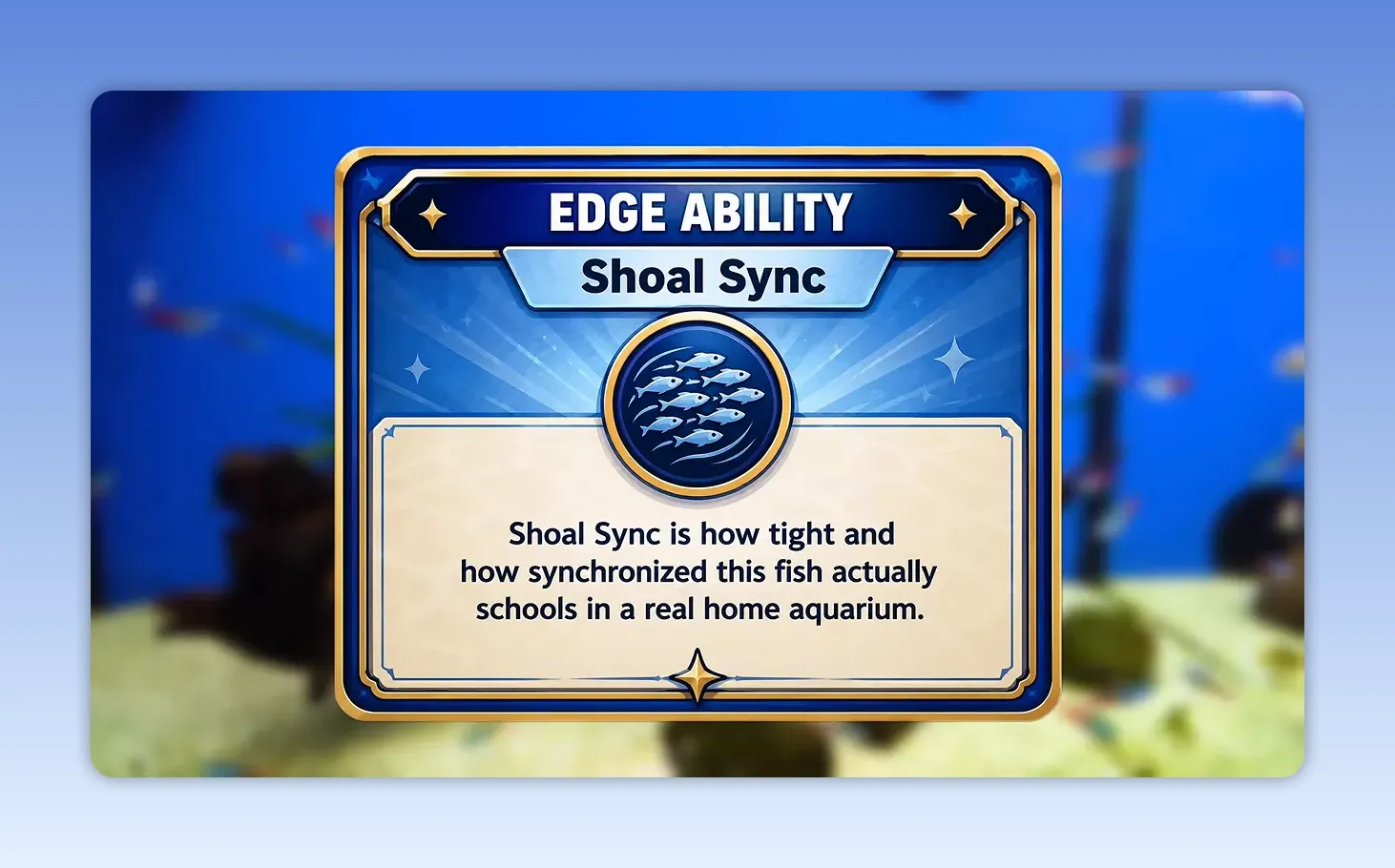
For an aquarium built around a coordinated group, shoal synchronisation should carry more weight than popularity alone. It describes how tightly and consistently a species stays together and moves as a group under ordinary aquarium conditions.
A practical five-part way to compare schooling fish
Choosing the best schooling fish requires more than judging colour. Compare potential species across these five qualities:
- Colour payoff: How much visual presence the fish adds once settled into an established aquarium.
- Hardiness: How forgiving the species is when conditions are less than perfect.
- Peacefulness: Whether it works well with suitable community tank mates or creates conflict through chasing and fin nipping.
- Availability: How realistically the fish can be found through ordinary aquarium shops.
- Shoal synchronisation: How tightly and consistently the group moves together. For a school-focused aquarium, this is the defining trait.
This framework also explains why beautiful fish do not always make the best schooling fish. A species may have spectacular colours yet disperse around the tank, while a more subtle fish can create a much stronger group effect.
Best schooling fish by aquarium priority
Best overall for tight schooling: Rummy nose tetra
Rummy nose tetras set an exceptionally high standard for group movement. In a sufficiently large group, their red faces and silver bodies can hold a close formation and change direction together. Their synchronised movement is the kind of display many aquarists expect when they search for a schooling fish.
They are a top choice for someone whose main goal is a unified, active shoal rather than simply keeping several similar fish together.
Best peaceful all-rounder: Harlequin rasbora
Harlequin rasboras combine a tight group presence with hardiness and peaceful community-tank behaviour. Their dark wedge-shaped marking becomes especially effective when repeated across a group, giving the school a clean, recognisable look even from across the room.
They are one of the most balanced selections for aquarists who want an attractive school without sacrificing calm behaviour or everyday practicality.
Best tiny orange school: Ember tetra
Ember tetras are small, peaceful, accessible, and capable of forming a compact orange cloud. Their individual colour is more restrained than that of a cardinal tetra, but a group can deliver a strong visual effect because it remains closely gathered.
They are an appealing choice when the goal is a small, warm-coloured school rather than a single large focal fish.
Best overlooked community school: Glowlight tetra
Glowlight tetras are a notably complete option. They offer a warm orange line, peaceful behaviour, beginner-friendly resilience, and a genuinely close shoal. They may receive less attention than neons or cardinals, but they have no obvious weakness when judged as a community schooling fish.
For a dependable school that provides both movement and colour, glowlight tetras deserve much more consideration.
Best compact blue-green school: Green neon tetra
Green neon tetras can form compact, cohesive groups that remain together more reliably than some flashier rainbowfish. Their shimmering blue-green colour offers a bright cool-toned accent while their tight grouping creates a clear schooling effect.
They are a strong option for aquarists who value shoal behaviour over sheer individual size or dramatic fins.
Best durable value pick: White cloud mountain minnow
White cloud mountain minnows are peaceful, hardy, widely available, and capable of tighter grouping than their modest reputation suggests. They may not have the showpiece appearance of a Denison barb, but they offer a remarkably strong all-round package for a fish that is often inexpensive and underestimated.
Beautiful fish that may school more loosely
A loose school is not a flaw in every aquarium. Many species are spectacular because of their colour, size, activity, or personality. The key is to select them with realistic expectations, especially if a tightly organised formation is the goal.
Cardinal tetra
Cardinal tetras are among the most visually striking fish in the comparison. Their long red and blue colour pattern provides exceptional visual impact. However, their strength is colour payoff rather than especially tight schooling. Choose cardinals for a brilliant classic tetra display, not solely for maximum synchronisation.
Boesemani rainbowfish and neon dwarf rainbowfish
Both Boesemani rainbowfish and neon dwarf rainbowfish offer strong colour and activity. However, rainbowfish tend to school more loosely, with males often separating to display. Their appeal lies in their lively movement and colour rather than a compact, constantly unified school.
Congo tetra
Congo tetras can be among the most beautiful fish in an aquarium, with flowing fins and gold-blue tones. Yet their larger size and tendency for males to display can break up the formation. They are a strong aesthetic choice, but not the top fit for an aquarium designed around tightly coordinated schooling.
Celestial pearl danio
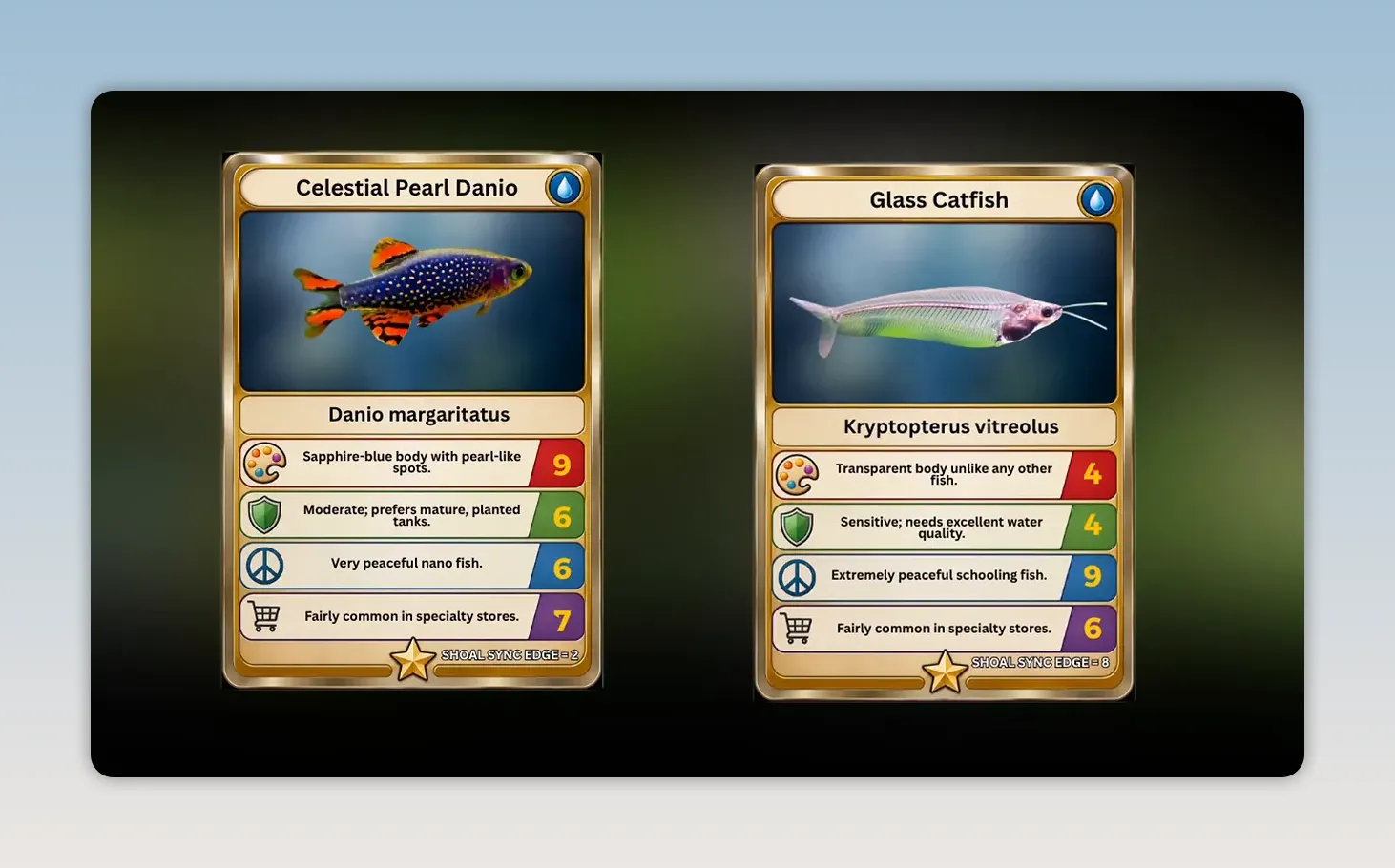
Celestial pearl danios have pearl-like spots and orange fin colour that make them visually memorable. In a group, however, they may scatter, hide, and spend time sparring or behaving as separate individuals. They are beautiful nano fish, but should not be selected primarily for a consistent schooling display.
Community fish that need careful consideration
Schooling behaviour is only one part of stocking a successful aquarium. A fish can move as a group and still be a problematic choice with delicate or long-finned tank mates.
Tiger barbs
Tiger barbs have attractive colour and energetic group movement, but they have a reputation for fin nipping. Their activity can look excellent in an appropriate setup, yet their lower peace rating makes them a poor default choice for a gentle mixed community.
Serpae tetras
Serpae tetras are colourful and can move actively in groups, but they can also be aggressive fin nippers. They should not be treated as harmless community schoolers simply because they are small and colourful.
Glass catfish
Glass catfish present a special case. They are fragile and depend heavily on being kept in a proper group. When kept alone or in an insufficiently sized group, they may become stressed and stop eating. In a group of roughly six to ten, they can hover together in a striking transparent formation.
Their close grouping is impressive, but their sensitivity means they suit an aquarist prepared to meet their social needs rather than someone seeking the most forgiving first schooling fish.
Round of 32 results: which schooling fish advanced?
The following head-to-head results show how a school-focused ranking can produce surprises. In each pairing, colour, resilience, peacefulness, availability, and shoal synchronisation were weighed together, with synchronisation given the greatest importance.
Advancing from the first group
- Cardinal tetra over black skirt tetra
- White cloud mountain minnow over Denison barb
- Serpae tetra over cherry barb
- Ember tetra over rosy barb
Advancing from the second group
- Rummy nose tetra over dwarf emerald rasbora
- Lemon tetra over pygmy corydoras
- Green neon tetra over neon dwarf rainbowfish
- Chili rasbora over lambchop rasbora
Advancing from the third group
- Harlequin rasbora over bloodfin tetra
- Black neon tetra over Congo tetra
- Tiger barb over marbled hatchetfish
- Boesemani rainbowfish over blue emperor tetra
Advancing from the fourth group
- Neon tetra over threadfin rainbowfish
- Zebra danio over pristella tetra
- Glowlight tetra over diamond tetra
- Glass catfish over celestial pearl danio
Why famous schooling fish are not always the best choice
Neon tetras are among the most recognised aquarium fish, but fame does not guarantee they are the strongest all-round schooler. Their colour can look less intense beside cardinal tetras, their schooling can be loose, and their hardiness is not always as dependable as their popularity suggests.
The same lesson applies to several well-known fish: recognisability, store availability, and beauty matter, but they should not replace an assessment of actual behaviour in the aquarium. A species that stays compact, remains peaceful, and handles normal aquarium life well may create a better long-term display than a more famous alternative.
How to choose the right schooling fish for your tank
Before selecting a species, decide what result you want the group to create.
- Want the strongest coordinated movement? Start with rummy nose tetras, harlequin rasboras, green neon tetras, ember tetras, or glowlight tetras.
- Want maximum colour? Consider cardinal tetras, chili rasboras, Congo tetras, or Boesemani rainbowfish, while accepting that some form looser groups.
- Want a peaceful community fish? Harlequin rasboras, ember tetras, glowlight tetras, white clouds, lemon tetras, and black neon tetras are better fits than fin-nipping barbs and serpae tetras.
- Want a small fish with a compact visual effect? Ember tetras, chili rasboras, green neon tetras, and dwarf emerald rasboras are worth comparing.
- Want a distinctive specialist group? Glass catfish can be remarkable, but only when their need for a proper group is taken seriously.
Common mistakes when buying schooling fish
Assuming every social fish forms a tight school
Social behaviour and schooling behaviour are related but not identical. A fish may be more comfortable with companions while still spending most of its day dispersed around the aquarium.
Choosing only by the fish shop display
Store lighting and temporary group behaviour can make a fish appear more colourful or more tightly grouped than it will be after settling into a home aquarium. Judge the species by its usual adult aquarium behaviour, not only its immediate first impression.
Ignoring peace ratings
Active group movement does not make a fish automatically suitable for a community tank. Tiger barbs and serpae tetras can be visually appealing schoolers while still creating trouble through fin nipping.
Keeping group-dependent fish in too small a number
Glass catfish are an important warning example. They are especially vulnerable when isolated or placed in very small groups. Their wellbeing and their best group behaviour depend on having enough companions.
Final takeaway: the best schooling fish depends on what you value
If tight, coordinated schooling is the main goal, rummy nose tetras establish the benchmark. For a calm, practical, and attractive community-schooling fish, harlequin rasboras and glowlight tetras are exceptionally balanced. For a compact orange display, ember tetras are hard to overlook, while white cloud mountain minnows offer outstanding resilience and value.
The most rewarding choice is not always the most famous species. Build around the behaviour you want to see, then balance it with colour, temperament, and the needs of the rest of the aquarium.
Frequently asked questions
What is the best schooling fish for a tight shoal?
Rummy nose tetras are an outstanding choice for a tight, synchronised shoal. Their ability to turn and travel as a cohesive group makes them a standard against which other schooling fish can be compared.
Are neon tetras the best schooling fish for beginners?
Neon tetras are famous and widely available, but they are not automatically the best overall choice. Their schooling is relatively loose and their hardiness can be less dependable than their reputation suggests. Glowlight tetras, harlequin rasboras, and white cloud mountain minnows offer compelling alternatives.
Which schooling fish are peaceful for community tanks?
Harlequin rasboras, ember tetras, glowlight tetras, white cloud mountain minnows, lemon tetras, and black neon tetras are strong peaceful community candidates in this comparison.
Do cardinal tetras school tightly?
Cardinal tetras are exceptional for colour, but their advantage is visual impact rather than the tightest group synchronisation. They are an excellent choice for a bright tetra display, while rummy nose tetras and several rasboras are stronger picks when close formation is the priority.
Are tiger barbs good community schooling fish?
Tiger barbs can look excellent in an active group, but their fin-nipping reputation makes them a more selective choice. Avoid treating them as a universal fit for peaceful mixed community tanks.