Brackish aquariums can be planted, but plant choice has to follow the salinity requirements of the fish, not the other way around. Most common aquarium plants are adapted to freshwater and decline once salt levels rise. The dependable exceptions are a short, useful group that can create cover, height, texture and a natural-looking substrate layer in low to moderate brackish water.
The strongest options are Vallisneria, Cryptocoryne ciliata, Java fern, Java moss and Bacopa monnieri. Other familiar plants can work at the lowest end of the range, but their limits may be below what fish such as figure 8 puffers and archerfish require.
Table of Contents
- Why most aquarium plants fail in brackish water
- Specific gravity comes before plant selection
- Quick ranking of brackish aquarium plants
- S-tier plants: the best foundation for a planted brackish tank
- A-tier plants: reliable texture, cover and vertical growth
- B-tier plants: workable only when conditions are controlled
- C-tier plants: why they are often poor long-term choices
- How to acclimate plants to brackish water
- How to design a planted brackish aquarium
- Common mistakes with brackish aquarium plants
- Frequently asked questions
- Final takeaway
Why most aquarium plants fail in brackish water
Saltwater exposure creates osmotic stress for plants that evolved in freshwater. As salinity rises past a species' tolerance, water moves out of plant cells across their membranes. The result is usually gradual rather than dramatic: growth slows, leaves become translucent, and the plant eventually melts or sheds foliage.
This is why a plant that looks healthy in a shop's freshwater tank is not automatically suitable for a brackish aquarium. Toughness in ordinary freshwater conditions does not necessarily mean tolerance of salt.
Specific gravity comes before plant selection
The essential measurement for a planted brackish setup is specific gravity. Freshwater sits at approximately 1.000. Light brackish water is roughly 1.002 to 1.005, with more saline systems rising beyond that.
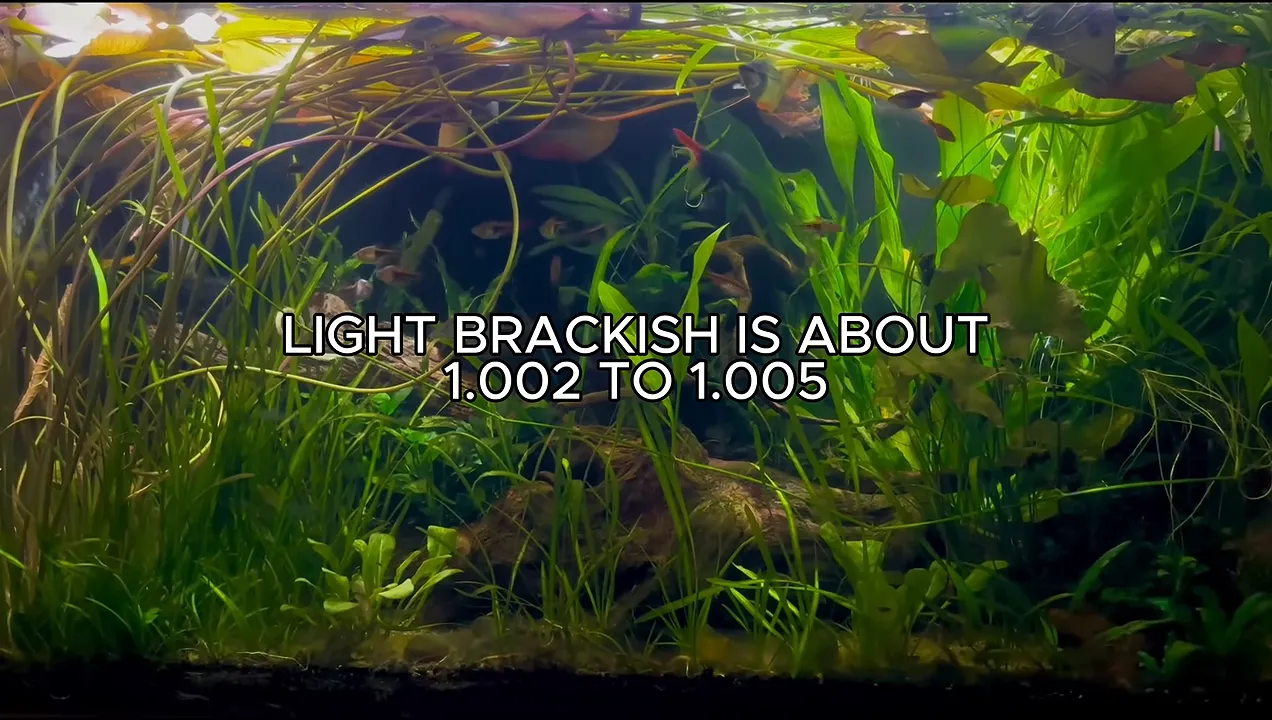
A figure 8 puffer commonly falls around 1.005 to 1.008, while archerfish may need conditions closer to 1.010 to 1.015. This creates the central challenge of brackish planting: a plant that tolerates a trace of salt may still fail at the specific gravity needed by the animal in the aquarium.
Choose the fish and target salinity first. Then select plants proven to tolerate that number. Do not keep salinity too low simply to preserve a marginal plant if it conflicts with the needs of the livestock.
Quick ranking of brackish aquarium plants
| Tier | Plants | What the rating means |
|---|---|---|
| S tier | Vallisneria, Cryptocoryne ciliata | Excellent choices that genuinely suit brackish conditions and can form the basis of a planted layout. |
| A tier | Java fern, Java moss, Bacopa monnieri | Reliable options for appropriate low-salinity brackish systems, each with a distinct role in the aquascape. |
| B tier | Water sprite, Anubias, Sagittaria subulata | Usable with careful conditions, gradual acclimation or a limited salinity ceiling. |
| C tier | Hornwort, water lettuce, mangroves | Possible in narrow circumstances, but often mismatched to fish requirements or standard aquarium design. |
S-tier plants: the best foundation for a planted brackish tank
Vallisneria
Vallisneria is the standout all-round brackish aquarium plant. Its long ribbon leaves bring height and movement to the background, while runners spread across the substrate and build dense planted areas over time.
It is particularly well suited to the hard, alkaline, buffered chemistry that often accompanies brackish water. Vallisneria can use bicarbonate as a carbon source during photosynthesis, which helps explain why it can perform so strongly in these conditions.
Most importantly, its salinity tolerance extends beyond the needs of many common brackish fish. Rather than barely surviving at the low end, suitable Vallisneria strains have useful headroom above the range required by figure 8 puffers and archerfish.
- Best use: Background planting and large grass-like stands
- Strength: Broad salinity tolerance and runner-based spread
- Design value: Creates a dense, natural backdrop
Cryptocoryne ciliata
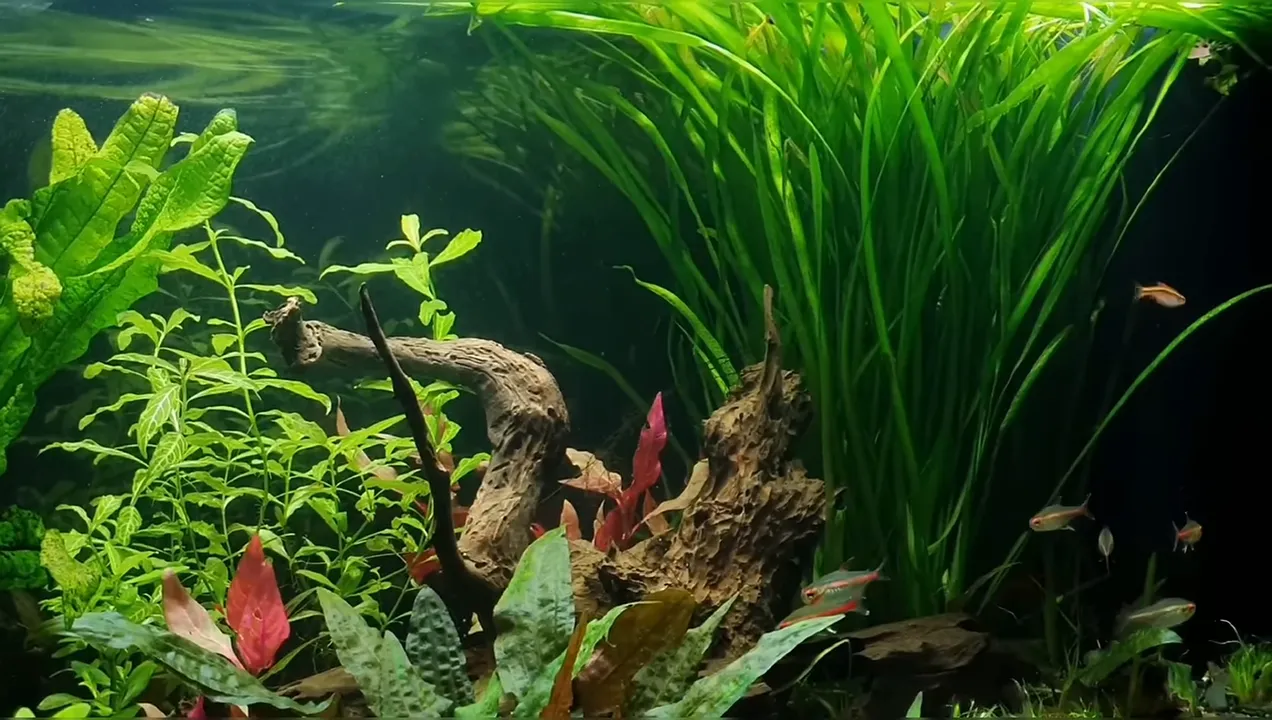
Cryptocoryne ciliata is unusual because it is genuinely native to brackish environments, including tidal areas and estuaries in Southeast Asia. That is a significant advantage over freshwater plants that need to be carefully pushed toward their salt limit.
It offers the rooted, rosette-style look many aquarists want from Cryptocoryne, but with real brackish credentials. While many other crypts are freshwater plants and can react badly even to ordinary changes in aquarium conditions, C. ciliata belongs in a salt-influenced system.
- Best use: Midground or rooted accent planting
- Strength: Native brackish-water origin
- Consideration: It may be harder to source than common freshwater crypts
A-tier plants: reliable texture, cover and vertical growth
Java fern
Java fern is one of the safest starting plants for a low-salinity brackish aquarium. It has a long reputation for holding up in figure 8 puffer tanks and similar setups where other plants fail.
Attach the rhizome to rock or driftwood rather than burying it in the substrate. This is especially helpful in brackish systems, where avoiding unnecessary substrate complications can simplify the setup. Java fern does not require bright lighting, grows slowly and creates sturdy structural foliage rather than a dense jungle effect.
- Best use: Hardscape planting on wood and rock
- Strength: No need for substrate or intense lighting
- Expectation: Slow, steady growth rather than rapid filling-in
Java moss
Java moss is a practical option at the lower end of brackish salinity. It may not spread as vigorously as it does in soft freshwater, but it can remain green, retain its form and provide valuable surface area.
Use it on wood, rocks or mesh to soften hardscape and create protected areas for fry. It also supports biofilm growth, adding useful microhabitat in an aquarium where plant choices are limited.
Bacopa monnieri
Bacopa monnieri is a worthwhile choice when a brackish aquascape needs upright stem growth. It occurs naturally in estuarine environments, giving it a stronger foundation for salt tolerance than many standard stem plants.
It is not a neglect-proof selection. Bacopa needs adequate light and benefits from feeding. Yellow leaves and stunted growth are useful warning signs that conditions need adjustment, which is preferable to plants that simply melt without clear early signals.
- Best use: Vertical midground and background stems
- Strength: Estuarine origin and distinctive upright texture
- Needs: Good light and consistent nutrition
B-tier plants: workable only when conditions are controlled
Anubias
Anubias has a deserved reputation for durability, but that does not make it immune to abrupt salinity change. It can work in brackish water, especially at lower salinity, if acclimated patiently.
The important rule is simple: raise salinity gradually over weeks, not days. Moving Anubias directly from freshwater into an established brackish aquarium can cause a severe osmotic shock and lead to leaf loss or melting.
Like Java fern, keep its rhizome above the substrate and attach it to hardscape. Its slow growth and broad, tough leaves make it useful as a shaded midground accent.
Sagittaria subulata
Dwarf Sagittaria is valuable because it can form a grass-like planted floor, something rhizome plants and rosettes cannot easily provide. It naturally occurs in estuarine settings, so salt is not entirely unfamiliar to the species.
It spreads through the substrate and can make a brackish layout look intentionally planted rather than sparsely decorated. However, it has a lower upper limit than Vallisneria, so it is better suited to low brackish conditions than systems pushed toward the higher end.
Water sprite
Water sprite provides unusual flexibility because it can be floated or rooted. It grows quickly in freshwater, can contribute to nutrient export and produces dense cover.
It appears to remain useful in brackish aquariums, but the evidence for its precise salt limit is less certain than for the most dependable choices. Treat it as an experiment for a low-end brackish setup, not as the main plant for an aquarium that needs steadily rising salinity.
C-tier plants: why they are often poor long-term choices
Hornwort
Hornwort can tolerate only the very bottom of the brackish range, around 1.002 to 1.003. Even there, it slows down substantially. Once salinity approaches what a figure 8 puffer commonly needs, hornwort may shed needles and foul the water column with decaying plant matter.
It is best treated as a low-salinity temporary option, not a dependable brackish plant.
Water lettuce
Water lettuce is attractive, fast-growing and useful for surface shade, but its salt tolerance is far too low for most true brackish fish systems. Its limit is about 2.5 parts per thousand, approximately 1.001 to 1.002 specific gravity.
That may technically qualify as slightly brackish water, but it is below the needs of many fish associated with brackish aquariums, including archerfish, figure 8 puffers and mollies. Keeping it alive by maintaining insufficient salinity is not a successful long-term compromise.
Mangroves
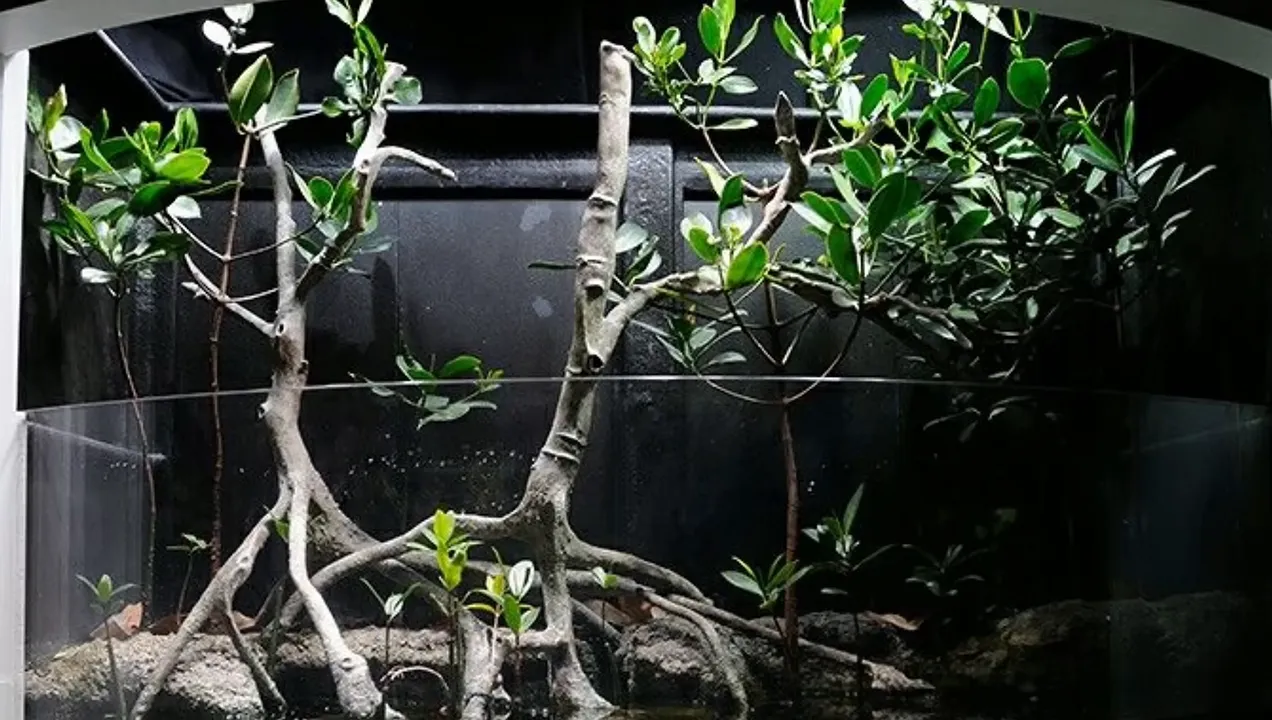
Mangroves have impeccable brackish-water credentials. Their roots are adapted to saline, waterlogged and oxygen-poor coastal conditions. The limitation is physical rather than ecological: mangroves are trees, not fully submerged aquarium plants.
They need their trunk, branches and leaves above the water with open vertical space and suitable humidity. A mangrove is an excellent choice for an open-top paludarium, but a poor fit for a standard covered aquarium.
How to acclimate plants to brackish water
Slow acclimation does not transform every freshwater plant into a brackish species, but it can make the difference for adaptable choices such as Anubias, Java fern and some other low-salinity candidates.
- Set the target salinity from the fish's needs. Do not select a number based only on plant tolerance.
- Measure specific gravity consistently. Know the actual value before adding plants.
- Increase salinity gradually. Spread changes across weeks rather than making a sudden transfer from freshwater to brackish water.
- Start with proven plants. Use Vallisneria, C. ciliata or Java fern as the foundation before testing marginal species.
- Inspect growth, not just survival. A plant that stays alive but stops growing, becomes translucent or loses leaves is not thriving.
- Remove decaying foliage promptly. Melting plants can add unnecessary organic waste to the aquarium.
How to design a planted brackish aquarium
A planted brackish aquarium does not need the species density of a high-tech freshwater aquascape. It needs plants assigned to clear roles and selected for the same salinity target.
A simple planting framework
- Background: Vallisneria for tall leaves, runners and dense visual cover.
- Midground: Cryptocoryne ciliata for rooted structure, with Bacopa monnieri where more vertical stems are wanted.
- Hardscape: Java fern and Java moss attached to driftwood or rocks.
- Floor: Sagittaria subulata in a low-brackish setup where its salinity ceiling is appropriate.
- Open-top feature: Mangroves only in a paludarium with room above the water.
This approach creates contrast without depending on plants that are likely to fail as the aquarium matures. Vallisneria supplies the bulk, Cryptocoryne ciliata adds rooted texture, and Java fern provides structure on wood and stone.
Common mistakes with brackish aquarium plants
- Calling any salted freshwater tank brackish. A trace of salt may keep water lettuce alive, but it does not necessarily meet the needs of genuine brackish fish.
- Buying plants before establishing the fish's salinity range. This leads to compromises that can harm livestock or waste money on plants.
- Assuming a hardy freshwater plant tolerates salt. Hornwort and Anubias illustrate why freshwater toughness and salt tolerance are different traits.
- Acclimating too quickly. Even a suitable plant can fail after a sudden osmotic shock.
- Expecting lush freshwater growth rates. Java moss and other adaptable plants may remain useful while growing more slowly in brackish water.
- Using mangroves in a sealed, covered aquarium. Their above-water growth requirement makes them unsuitable for that format.
Frequently asked questions
Can a brackish aquarium be heavily planted?
It can be attractively planted, but the plant list is much shorter than in freshwater. A layout built around Vallisneria, Cryptocoryne ciliata, Java fern and selected low-brackish companions can have substantial plant cover without relying on unsuitable freshwater species.
What is the best plant for a figure 8 puffer tank?
Vallisneria is the strongest overall option because it tolerates a broad salinity range and can grow beyond the typical needs of a figure 8 puffer. Java fern is also a reliable structural plant for low-salinity puffer setups.
Can Anubias live in brackish water?
Yes, Anubias can work in lower-salinity brackish water when it is acclimated gradually. Moving it directly from freshwater to brackish water can cause a damaging osmotic shock.
Is water lettuce a good brackish aquarium plant?
Usually no. Water lettuce only tolerates around 2.5 parts per thousand, or roughly 1.001 to 1.002 specific gravity. That is lower than the salinity required by many fish kept in true brackish systems.
Can mangroves grow in an aquarium?
Mangroves can work in an open-top paludarium where their roots remain in water while their trunk and leaves grow above it. They are not a practical choice for a normal covered aquarium.
Final takeaway
Successful brackish planting begins with matching plants to the aquarium's real specific gravity. For the most dependable result, build around Vallisneria and Cryptocoryne ciliata, then add Java fern, Java moss or Bacopa monnieri for texture and variety.
Keep salinity stable, acclimate adaptable plants slowly and judge success by sustained healthy growth rather than short-term survival. With those principles in place, a brackish aquarium can be planted, functional and visually compelling.