Cherry shrimp breeding is one of the most accessible ways to build a thriving freshwater shrimp colony at home. The key is not expensive equipment or chasing flawless water numbers. It is creating a mature, stable shrimp-only aquarium with suitable minerals, gentle filtration, modest feeding and a clear plan for maintaining colour quality.
This guide focuses on Neocaridina davidi, the group that includes cherry shrimp, Sakura, Fire Red, Painted Fire Red, Blue Velvet and Blue Dream shrimp. These shrimp are generally the most beginner-friendly ornamental shrimp because they can breed successfully in reasonable tap water when conditions remain consistent.
Table of Contents
- Why Neocaridina cherry shrimp are best for beginner breeders
- Cherry shrimp tank setup for breeding
- Ideal cherry shrimp water parameters
- Plants, leaves and light for a productive shrimp colony
- Feeding cherry shrimp without polluting the tank
- How cherry shrimp breed: saddled females, berried females and babies
- How to acclimate new cherry shrimp safely
- Do fish eat baby cherry shrimp?
- Colour grading, culling and line breeding cherry shrimp
- Can you make money breeding cherry shrimp?
- Four mistakes that can wipe out a shrimp colony
- Cherry shrimp breeding action plan
- Frequently asked questions
- Final takeaway
Why Neocaridina cherry shrimp are best for beginner breeders
Ornamental freshwater shrimp are commonly grouped into Caridina, Sulawesi and Neocaridina. While all can be beautiful, they do not require the same level of water control.
- Caridina, including crystal red and tiger shrimp, typically need soft, acidic water, remineralised reverse osmosis water and a buffering substrate.
- Sulawesi shrimp prefer warmer, more alkaline water and are more demanding to keep stable.
- Neocaridina sit between those extremes and can often breed in local tap water when its parameters are suitable.
That tolerance makes Neocaridina a sensible species for learning colony management, acclimation, feeding, selective breeding and basic water testing before attempting more expensive shrimp.
Cherry shrimp tank setup for breeding
A breeding tank should prioritise stability, surface area and safe places for tiny shrimplets to graze. A 10-gallon aquarium is a practical minimum, but a 20-gallon long is an even stronger option if space allows. More water changes temperature and water chemistry more slowly, reducing sudden stress.
Essential equipment checklist
- A fully cycled aquarium of at least 10 gallons
- A sponge filter, ideally in the 25 to 30 pores-per-inch range
- Dark substrate
- A reliable thermometer
- A TDS meter
- A freshwater test kit for ammonia, nitrite, nitrate and pH
- Java moss, Subwassertang, Cryptocoryne or similar shrimp-friendly plants
- An Indian almond leaf
- A feeding dish
A sponge filter is especially useful because it provides biological filtration without sucking up babies. Its large surface area supports beneficial bacteria that process toxic ammonia and nitrite.
Choose dark substrate when possible. A dark base improves contrast and can support stronger visible pigmentation in coloured shrimp. It also makes pale or poorly coloured shrimp easier to identify when grading a colony.
Cycle and mature the tank before adding shrimp
Do not add shrimp to a brand-new aquarium. Run the filter for several weeks and allow the tank to develop biofilm, algae and microbial life. Shrimp graze continuously, and a slightly established aquarium offers far more natural food than a pristine setup.
A mature tank does not mean neglected water quality. It means a cycled system with a stable filter, established surfaces and no detectable ammonia or nitrite.
Ideal cherry shrimp water parameters
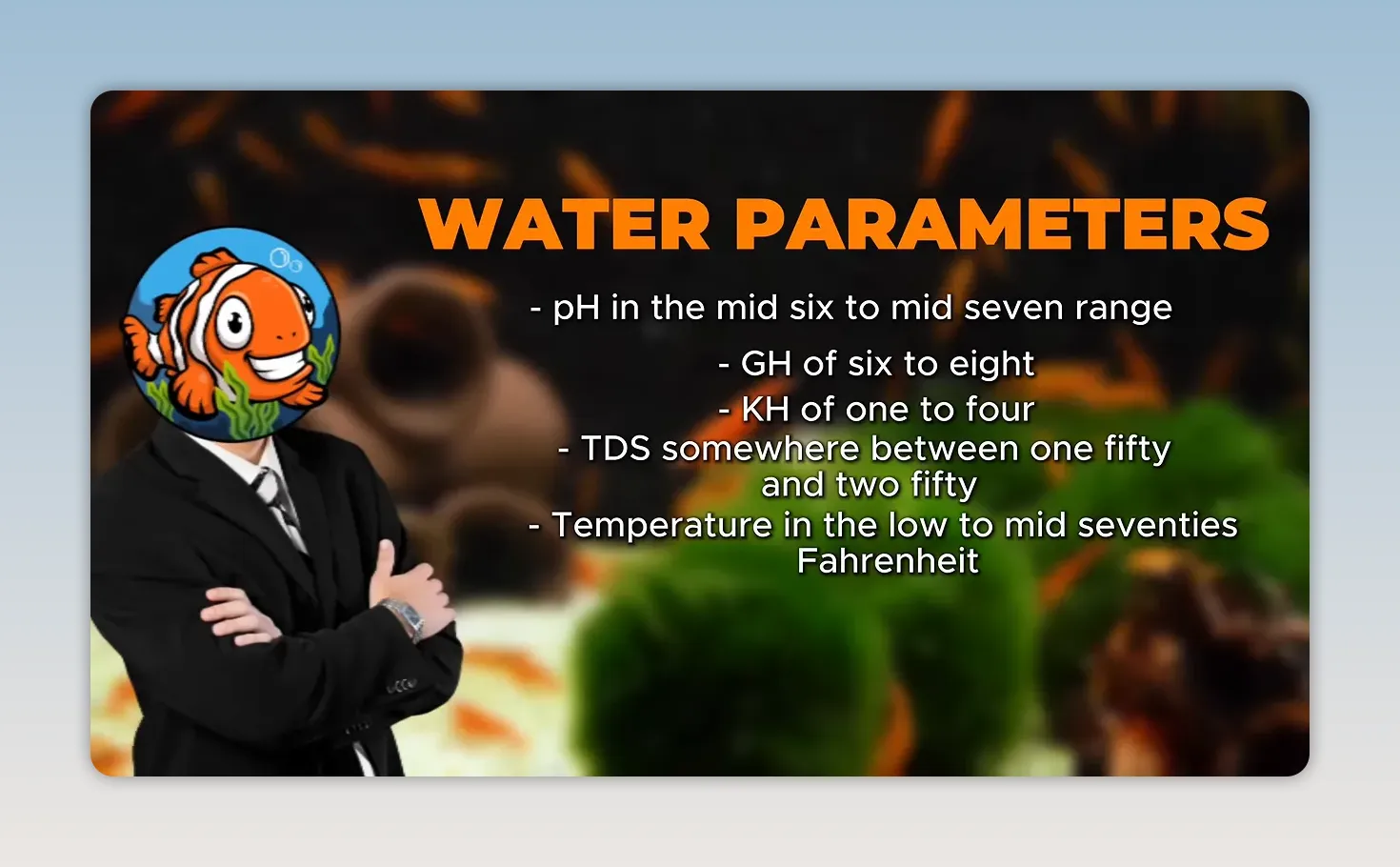
For Neocaridina breeding, consistency matters more than constantly adjusting a tank toward a single “perfect” number. Aim for the following ranges:
| Parameter | Target range | Why it matters |
|---|---|---|
| pH | Mid-6s to mid-7s | Provides a suitable middle-range environment for Neocaridina. |
| GH | 6 to 8 | Supplies minerals important for successful moulting. |
| KH | 1 to 4 | Supports water stability. |
| TDS | 150 to 250 | Helps track the overall amount of dissolved material in the water. |
| Temperature | Low to mid-70s Fahrenheit | Promotes stable conditions without rapid swings. |
Avoid temperature changes greater than roughly 1 to 3 degrees in either direction. Small tanks can heat rapidly in direct sun, so ambient daylight from a window is fine, but direct sunlight striking the glass is not.
Why GH is critical for moulting
When shrimp struggle to moult, many keepers immediately change food. In a Neocaridina tank, low general hardness is often the more likely cause. A failed moult can leave a white ring around the body or result in a shrimp becoming trapped in its old shell.
If your source water is too soft, options for raising hardness include crushed coral in the filter, a shrimp mineral product such as GH/KH remineraliser, or cuttlebone in the aquarium. Make changes carefully and avoid sudden parameter jumps.
Plants, leaves and light for a productive shrimp colony
Plants are not just decoration in a breeding tank. Mosses and fine-leaved plants provide grazing surfaces, shelter for babies and places where biofilm develops. Java moss, Subwassertang and Cryptocoryne are useful choices.
Malaysian trumpet snails can also be beneficial in a shrimp breeding setup. They help turn over the substrate, consume algae and decaying plant material, and contribute to the food web that supports grazing shrimp.
Keep an Indian almond leaf in the tank as an ongoing food and cover source. It gradually develops biofilm and releases mild tannins. Shrimp will graze on the leaf as it breaks down.
Lights are optional for shrimp themselves. Use lighting primarily for plants and avoid leaving it on all day. A dark period is important, and excessive lighting usually means more algae maintenance.
Feeding cherry shrimp without polluting the tank
Overfeeding is one of the most common causes of unexplained shrimp losses. Uneaten food decays, ammonia rises and a small colony can be affected before the problem is obvious.
- Feed less than the package directions suggest.
- Use a feeding dish so uneaten food is easy to see and remove.
- Remove leftovers after one day.
- Use occasional supplements sparingly, such as a small piece of boiled spinach once a month.
- Choose plant fertilisers specifically labelled shrimp safe.
Biofilm should remain the foundation of the diet. Supplemental food is useful, but a mature shrimp tank should not depend on heavy feeding.
How cherry shrimp breed: saddled females, berried females and babies
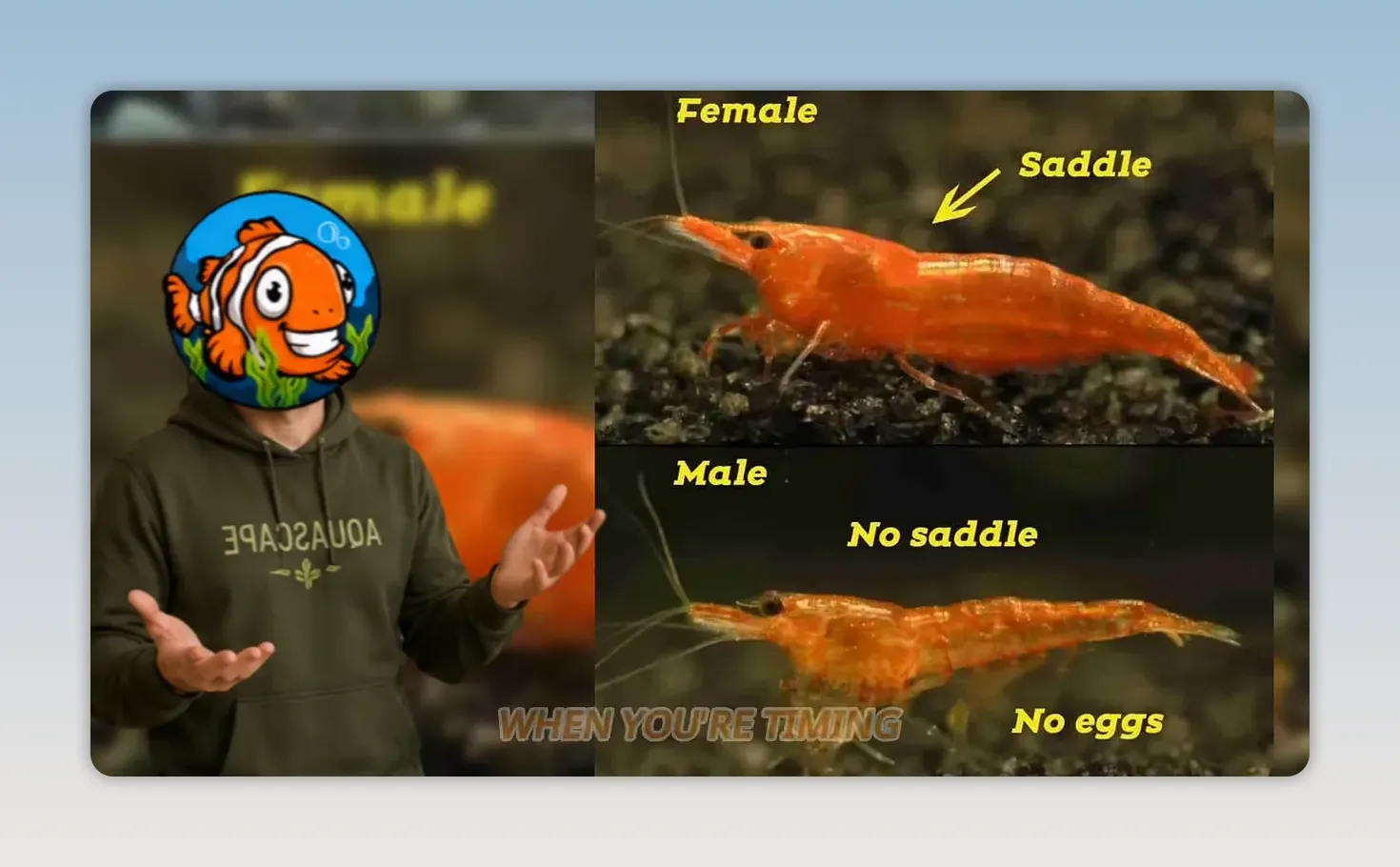
Female cherry shrimp are generally larger, rounder and more intensely coloured than males. A female may develop a visible saddle behind her head. This is a patch of developing eggs in her ovaries.
After mating, the female carries fertilised eggs beneath her tail. At this stage she is called berried. The distinction matters: a saddled shrimp has not yet moved eggs beneath her abdomen, while a berried shrimp is already carrying them.
When a female moults, she releases pheromones that attract males. Once fertilised, she carries the eggs for about a month. Neocaridina babies hatch as fully formed miniature shrimp. There is no larval stage and no saltwater stage, which is a major reason they are easier to breed than Amano shrimp.
Should you move a berried female to another tank?
If you use a second tank, move the female while she is carrying eggs, not after they hatch. Newborn shrimp are far too small to collect effectively with a net.
However, moving a berried female can cause stress and may lead to dropped eggs. Many breeders avoid the transfer entirely by using a dedicated shrimp-only breeding tank. A second aquarium is often more useful as a cull tank for lower-grade shrimp than as a nursery.
Moult or dead shrimp: how to tell the difference
A transparent, ghost-like shell is a normal moult. Leave it in the aquarium because shrimp may consume it and reclaim minerals. A solid, opaque body is a dead shrimp and should be removed.
How to acclimate new cherry shrimp safely
New shrimp can die from sudden differences in temperature, TDS or water chemistry. Drip acclimation gives them time to adjust gradually.
- Float the unopened transport bag so the temperature can equalise.
- Move the shrimp and their water to a clean bucket or container.
- Run airline tubing from the aquarium to the container.
- Adjust the flow to roughly two drops per second.
- Allow 30 to 60 minutes for gradual acclimation.
This process is slower than simply pouring shrimp into the aquarium, but it reduces the shock caused by abrupt water changes.
Do fish eat baby cherry shrimp?
Yes. Nano fish may coexist with adult shrimp in a casual community aquarium, but babies will be lost. Otocinclus are among the safer options, while rasboras, guppies, kuhli loaches and endlers may eat vulnerable shrimplets.
For a breeding or selling project, use no fish. If a shrimp fits in a fish’s mouth, it can become food. A shrimp-only tank gives babies the best chance to survive and makes population growth more predictable.
Colour grading, culling and line breeding cherry shrimp
Cherry, Sakura, Fire Red, Painted Fire Red, Blue Velvet and Blue Dream shrimp are colour forms of the same species. Wild-type Neocaridina are much duller, typically brownish-green. Bright colour is maintained through selective breeding.
In red lines, colour quality generally progresses from cherry to Sakura, Fire Red and Painted Fire Red. The higher grades show deeper, more opaque and more consistently saturated colour. The blue line commonly progresses from Blue Velvet to Blue Dream.
How to cull shrimp without ruining your line
Culling means removing the palest or least saturated shrimp from the primary breeding tank. These shrimp can be sold at a lower price or kept in a separate display colony. Keep the best-coloured shrimp together for breeding.
When evaluating quality, pay special attention to males. Males are naturally paler than females, so a strongly coloured male is a good sign that the line is improving.
Why you should not mix colour lines
Mixing colour morphs may seem appealing, but it makes colour quality less predictable and can lead a colony back toward wild-type brown coloration over generations. If your goal is a premium line, choose one colour and maintain it separately.
Preventing problems from long-term inbreeding
Selective breeding within a closed colony can improve colour, but it also carries a risk of inbreeding depression over many generations. Periodically outcross by adding unrelated shrimp from another breeder with the same colour target.
A practical schedule is to refresh genetics every 6 to 12 months. This combines two useful goals: retaining the colour you are selecting for while adding genetic diversity.
Can you make money breeding cherry shrimp?
Cherry shrimp breeding is better treated as a hobby that can offset aquarium costs than as a high-income business. A single tank is unlikely to produce large profits, and selling stock consistently is often more difficult than breeding it.
A colony started with roughly 10 to 15 shrimp can grow beyond 100 shrimp in about six months under stable conditions. Basic cherry shrimp commonly sell for around $1 to $3 each, while consistently graded premium lines may sell for $5 to $8 or more at retail.
Retail pricing is not the same as the amount received from a local fish store. Shops buy wholesale, so expect a lower offer. Before setting up a colony around a specific colour, ask local stores which varieties and quantities they actually want.
Best places to sell home-bred shrimp
- Local fish stores: Usually the simplest first outlet, though wholesale prices are lower.
- Local aquarium clubs and auctions: A strong option because buyers are already interested in the hobby and shipping is unnecessary.
- Online hobbyist marketplaces: Useful later, once you have a reliable reputation and understand live-shrimp shipping.
Shipping requires specialised supplies such as breather bags and seasonal heat or cold packs. It is best approached after gaining experience with local sales and stable colony management.
Four mistakes that can wipe out a shrimp colony
1. Copper contamination
Copper can be present in fish medications, some plant fertilisers and even hot tap water. Use shrimp-safe products only. If copper has been dosed in an aquarium, replace the substrate before using that tank for shrimp again.
2. Overfeeding
Food that is ignored becomes waste, and waste can create an ammonia spike. Feed lightly, check the feeding dish and remove leftovers promptly.
3. Mixing colour morphs
Combining different colour lines undermines selective breeding and can produce dull, unpredictable offspring. Keep one clean line per breeding tank.
4. Adding shrimp before the tank is mature
New tank syndrome is especially hard on shrimp because immature filtration and limited biofilm leave little margin for error. Cycle the tank first and give it time to develop.
Cherry shrimp breeding action plan
- Choose one Neocaridina colour line and begin with 10 to 15 shrimp.
- Set up a 10-gallon or larger shrimp-only tank with dark substrate and a sponge filter.
- Cycle and mature the aquarium for several weeks.
- Maintain stable pH, GH, KH, TDS and temperature within the recommended ranges.
- Add moss, plants, an Indian almond leaf and safe grazing surfaces.
- Drip acclimate new shrimp before release.
- Feed lightly and keep ammonia and nitrite at safe levels.
- Allow the colony to breed in place rather than repeatedly netting females.
- Move low-grade shrimp to a separate cull tank and keep the best colours breeding together.
- Outcross with unrelated shrimp of the same colour target every 6 to 12 months.
Frequently asked questions
How long does it take cherry shrimp to breed?
A berried female carries fertilised eggs for about a month before they hatch. Under stable conditions, a small starter colony can grow substantially over several months.
How many babies should a cherry shrimp have?
If batches consistently produce fewer than 20 babies, review water quality and feeding. Low survival or low baby numbers are usually a husbandry issue rather than bad luck.
Do cherry shrimp need a heater?
The important factor is maintaining a stable temperature in the low to mid-70s Fahrenheit. Whether a heater is needed depends on how stable the room temperature is.
Can cherry shrimp breed in tap water?
Yes, Neocaridina can breed in regular tap water when it is reasonably suitable and remains stable. Test GH, KH, pH and TDS rather than assuming the water is appropriate.
Should I remove a berried cherry shrimp?
It is not necessary in a dedicated shrimp-only tank. If you choose to move one, do it while she is carrying eggs, but recognise that netting can stress her and cause egg loss.
Final takeaway
Successful cherry shrimp breeding comes down to stable water, a mature tank, safe filtration and patient colony management. Start with an affordable Neocaridina line, learn to raise one full generation successfully and only then consider more demanding shrimp or premium colour projects.
With disciplined feeding, careful culling and periodic outcrossing, a well-managed colony can remain healthy, improve in colour and potentially help fund the aquarium hobby over time.