Choosing the best aquarium filter comes down to the needs of your tank, the space available and the kind of maintenance routine you prefer. Hang-on-back filters, sponge filters and canister filters can all support a successful freshwater aquarium. The right choice is not necessarily the most expensive or most advanced-looking option.
Use this guide to compare how each filter works, where it performs best and the trade-offs to consider before setting up your aquarium filtration.
Table of Contents
- Quick answer: which aquarium filter should you choose?
- What aquarium filtration needs to do
- Hang-on-back filters: convenient and accessible
- Sponge filters: simple biological filtration and aeration
- Canister filters: maximum customisation with hidden equipment
- HOB vs sponge vs canister filter comparison
- How to choose the right filter for your setup
- Common aquarium filter mistakes to avoid
- Can you use more than one aquarium filter?
- Frequently asked questions
- Final takeaway
Quick answer: which aquarium filter should you choose?
- Choose a hang-on-back, or HOB, filter when you want a lower-cost filter with fast, convenient maintenance and adjustable flow.
- Choose a sponge filter when biological filtration, surface agitation and the ability to seed another aquarium are priorities.
- Choose a canister filter when you want the most room for customised filter media, a clean tank presentation and flexible intake and outlet placement.
It is also perfectly reasonable to use more than one filter type. For example, a canister filter can hold extensive biological media below the aquarium while a HOB filter provides easily accessible mechanical filtration.
What aquarium filtration needs to do
An aquarium filter moves water through material that captures debris and provides surface area for beneficial bacteria. Filter setups can also include media chosen for a specific chemical filtration purpose.
When comparing filters, focus on these practical questions:
- How easily can accumulated debris be removed?
- How much biological media can the filter hold?
- Can the flow be adjusted for the animals and aquascape?
- Where will the filter sit: inside the tank, on its rear edge or under the stand?
- How much visible equipment are you comfortable having?
- How much time and space can you dedicate to maintenance?
Filtration is not a skill-level badge. HOB, sponge and canister filters can all be used by both new and experienced aquarists.
Hang-on-back filters: convenient and accessible
A hang-on-back filter mounts on the rear rim of the aquarium. Water is drawn into the unit, passed through its media and returned to the aquarium from the filter body.
Why choose a HOB filter?
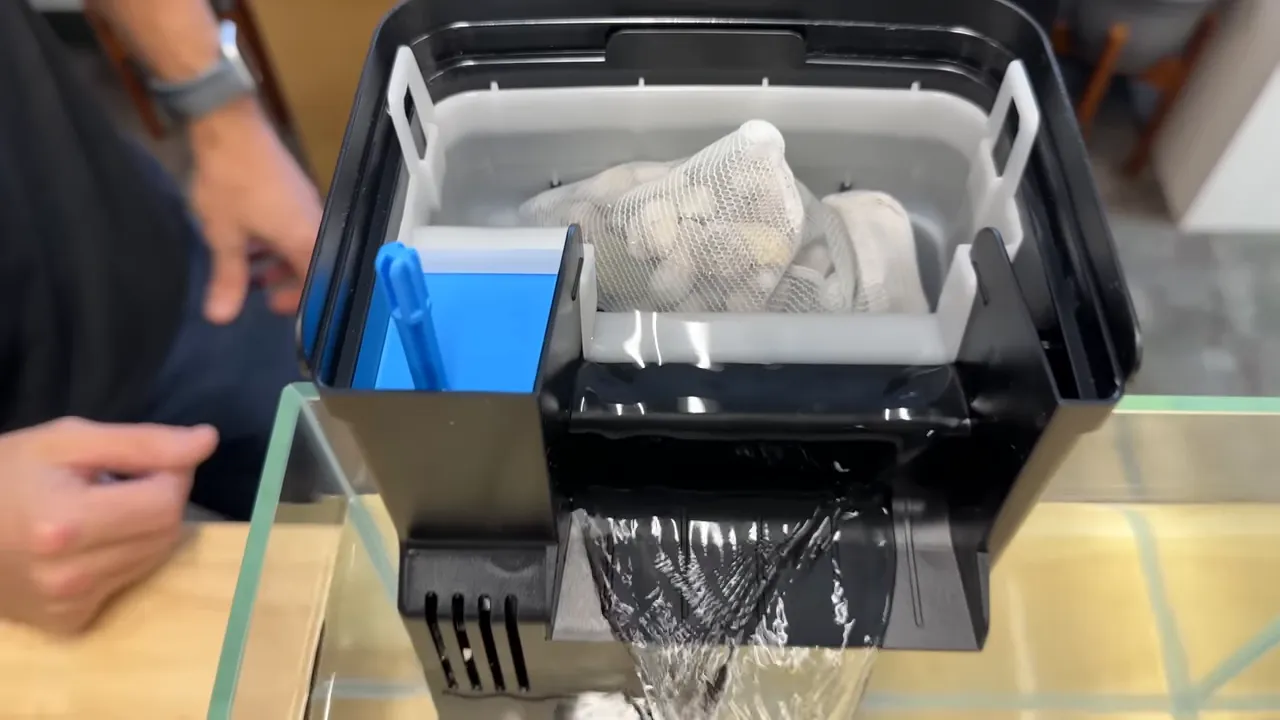
The main appeal of a HOB filter is simple maintenance. The lid and media tray can be accessed from above, allowing mechanical media to be removed and cleaned without disassembling a filter beneath the aquarium.
HOB filters are also generally less expensive than canister filters. This makes them a practical option when cost matters but convenient filtration is still important.
Features worth looking for in a HOB filter
- Adjustable flow: Being able to lower or increase water movement helps match the filter to the aquarium's inhabitants and layout.
- An internal pump: A pump positioned in the aquarium can restart after a power interruption once power returns. External rear-mounted drives may be noisier and may not restart automatically after an outage.
- Accessible mechanical media: A removable tray or basket makes regular cleaning easier.
HOB filter limitations
A HOB filter has less media space than a canister filter, especially in smaller models. It may include coarse sponge for mechanical filtration and media that supports beneficial bacteria, but there may not be much remaining room for extensive media customisation.
It is also visible from the rear of the aquarium and requires clearance behind the tank. That matters if the aquarium must sit very close to a wall.
Intake placement is another consideration. A canister filter can use an intake that reaches close to the substrate, where detritus often settles. A HOB intake typically cannot be positioned as low.
Who is a HOB filter best for?
A HOB filter suits aquariums where easy, frequent mechanical-media maintenance matters most. It can also be a useful companion to a canister filter on a larger setup, taking on the easy-to-clean mechanical filtration role while the canister holds the bulk of the biological media.
Sponge filters: simple biological filtration and aeration
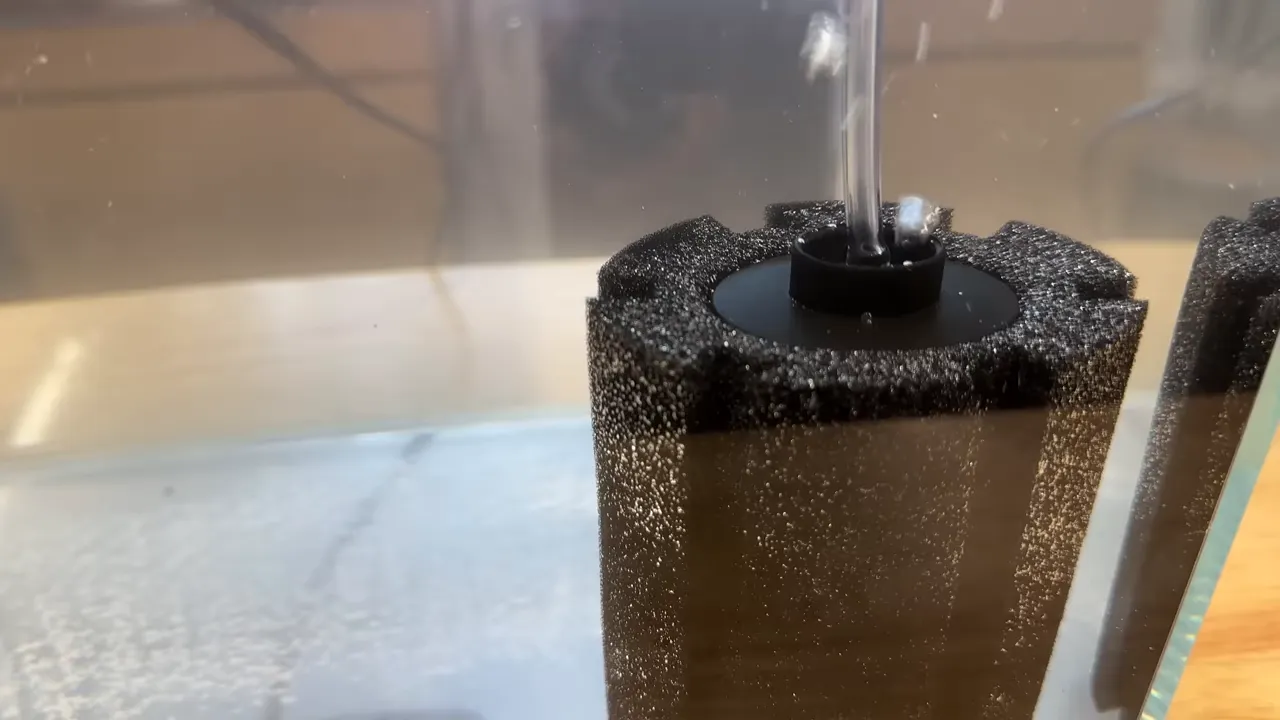
A sponge filter sits inside the aquarium and is powered by an airline connected to an air pump. Air rising through the uplift tube creates suction, drawing water through the sponge. The sponge catches material and offers extensive surface area for beneficial bacteria.
How a sponge filter works
A typical sponge filter has a weighted base, sponge body and central uplift tube. Air is introduced at the base of the tube. As bubbles rise, water is drawn through the surrounding sponge and lifted upward.
Advantages of sponge filters
- Strong biological-media potential: Beneficial bacteria can colonise the sponge throughout its surface.
- Useful for starting another tank: A sponge that has been running in an established aquarium can be moved to a new aquarium to introduce established beneficial bacteria.
- Surface agitation and oxygenation: The bubbles disturb the water surface while helping break up low-flow areas, which can be particularly useful in longer tanks.
- Adjustable output: An adjustable air pump can alter bubble volume and, in turn, the amount of flow through the filter.
- Optional uplift extension: Some sponge filters include an add-on tube that increases uplift and flow.
Sponge filter drawbacks
The most obvious drawback is visibility. The sponge, airline and bubbles are all within the aquarium. Plants can help conceal the filter, and sponge filters are available in different sizes, but they are not designed to disappear in the way an under-stand canister can.
Do not dismiss sponge filters as beginner-only equipment. They can be highly effective as the sole filter on some tanks and are also valuable in multi-aquarium setups because established sponges can be transferred to help establish biological filtration elsewhere.
Who is a sponge filter best for?
A sponge filter is a strong choice when you want a straightforward filter that supports biological filtration, adds surface movement and can be used to seed another aquarium. It is especially useful when maintaining a supply of established biological media is part of your aquarium routine.
Canister filters: maximum customisation with hidden equipment
A canister filter sits below the aquarium, usually inside the stand. Hoses carry water from the tank into the sealed canister and return filtered water back to the aquarium.
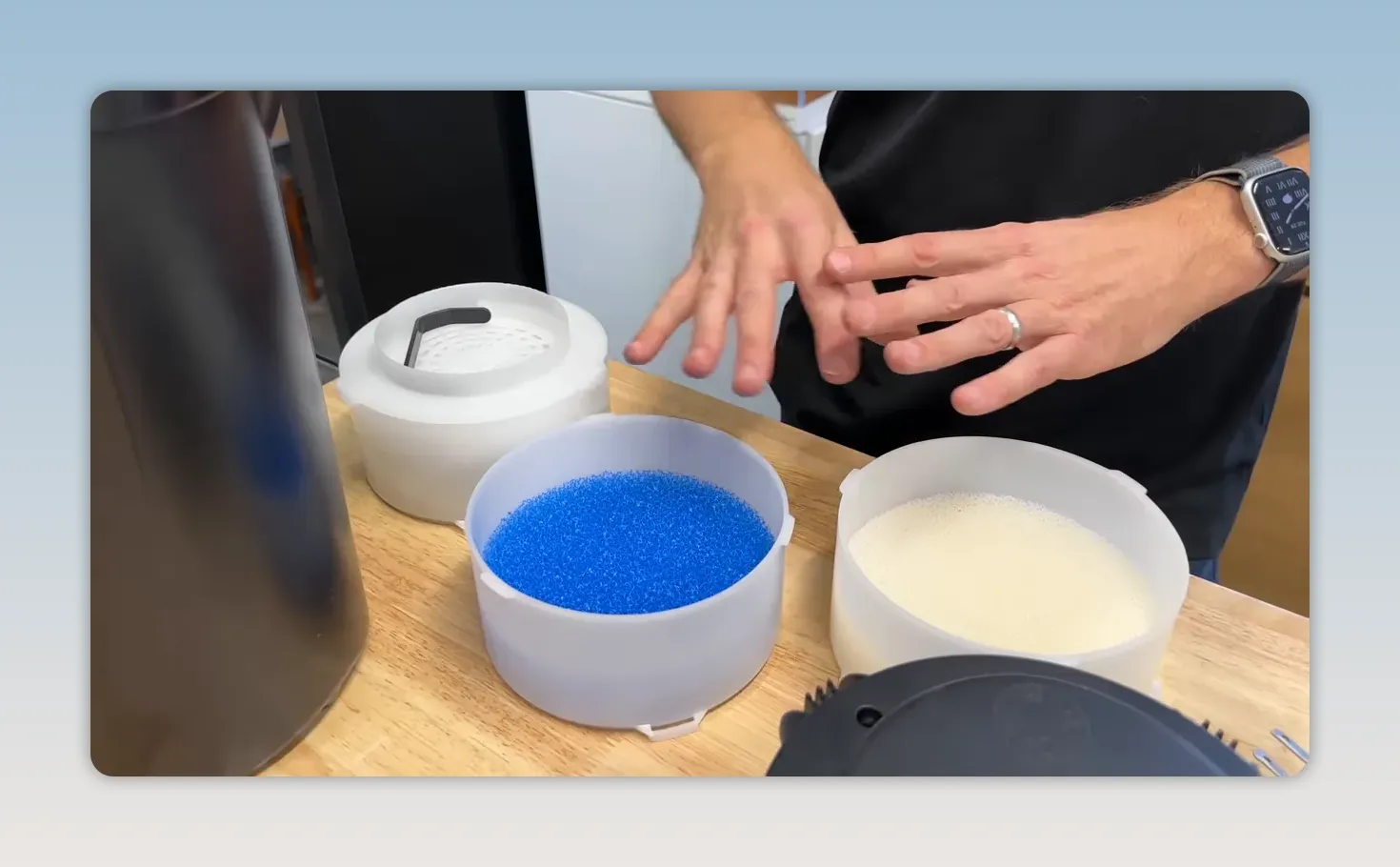
Its defining feature is capacity. Canister filters use multiple internal trays or baskets, creating more room to arrange mechanical, biological and chemical media to suit the aquarium.
Why choose a canister filter?
- Flexible media layout: Multiple trays allow you to dedicate space to different forms of filtration and change the arrangement when your setup changes.
- Hidden equipment: The main filter body sits below the aquarium rather than inside or behind it.
- Quiet operation: A canister filter can be quieter than bubbling air-driven filtration or a HOB with an external motor.
- Flexible intake and outlet options: The intake can be positioned near the substrate, and glass lily pipes can be used for a refined aquarium appearance.
Canister filter drawbacks
Canister filters are usually the most expensive of these three filter types. They also take up valuable room beneath the aquarium, so confirm that the stand has adequate space before choosing one.
Maintenance takes more steps than with a HOB filter. The filter must be opened, disconnected from the aquarium water source and its trays removed for cleaning. This is manageable, but it is more involved than lifting out a HOB media tray.
Are canister filters only for advanced aquarists?
No. A canister filter is not restricted to experienced aquarists. It can be an appropriate first filter if its price, stand space and maintenance process suit the setup. The important decision is whether its customisation and hidden placement solve real needs in your aquarium.
HOB vs sponge vs canister filter comparison
| Factor | Hang-on-back filter | Sponge filter | Canister filter |
|---|---|---|---|
| Typical cost | Lower than a canister filter | A simple air-driven setup | Generally the highest-cost option |
| Maintenance access | Very easy, with removable top-access media | Simple physical design | More involved, with hoses and trays to manage |
| Media customisation | More limited, especially in smaller units | The sponge serves as the main media | Highest flexibility with multiple trays |
| Placement | On the rear edge of the aquarium | Inside the aquarium | Below the aquarium |
| Visibility | Visible behind the tank | Visible in the tank | Main unit is hidden below the tank |
| Water movement | Often adjustable | Depends on air-pump output and uplift design | Can use flexible intake and outlet arrangements |
| Best distinctive use | Easy mechanical-media cleaning | Seeding another aquarium with beneficial bacteria | Large, tailored media capacity |
How to choose the right filter for your setup
1. Start with maintenance, not marketing
Choose the filter you will be comfortable maintaining. A HOB makes mechanical-media cleaning particularly quick. A canister provides more capacity but requires a more deliberate cleaning session. A sponge filter keeps the mechanics simple but remains visible in the aquarium.
2. Decide how much media flexibility you truly need
If you want substantial room to change biological, mechanical or chemical media, a canister filter offers the clearest advantage. If your setup only needs straightforward filtration with convenient access, a HOB may be the better fit. If the goal is a colonised sponge that can be moved to another aquarium, a sponge filter has a unique benefit.
3. Plan around aquarium placement
Measure the space behind and beneath the aquarium. A HOB needs room behind the tank. A canister needs under-stand clearance. A sponge filter needs space inside the aquarium and an airline route to its air pump.
4. Match water movement to your aquarium
Adjustable HOB flow and adjustable air-pump output can help tailor circulation. A canister filter also offers flexible intake and outlet placement. Consider where detritus collects and whether the setup has areas with limited circulation.
5. Consider the look you want
A canister keeps its main body out of sight and can be paired with glass lily pipes. A HOB remains visible at the back of the aquarium. A sponge filter is visible inside the tank, although plants may help camouflage it.
Common aquarium filter mistakes to avoid
- Assuming a HOB is only for beginners: HOB filters can be used by experienced aquarists and can serve as supplemental mechanical filtration on larger systems.
- Assuming a sponge filter is weak or ineffective: A sponge can support beneficial bacteria, filter water and improve surface agitation. It can also be the only filter on certain aquariums.
- Assuming a canister is required for success: Canister filters are useful, but a successful aquarium does not depend on owning one.
- Assuming a canister is too difficult for a first aquarium: It is a viable option for a new aquarist willing to accommodate its cost, size and maintenance routine.
- Ignoring restart behaviour after power interruptions: For HOB filters, consider whether the pump is internal and able to resume operation when power returns.
- Buying before measuring: Check rear clearance for a HOB and cabinet space for a canister before committing.
Can you use more than one aquarium filter?
Yes. Combining filters can separate tasks and make maintenance more convenient. One practical approach is a canister filter below the aquarium for substantial biological filtration, paired with a HOB filter that holds mechanical media which can be removed and cleaned quickly.
A sponge filter can also be maintained in an established aquarium as a source of colonised biological media for another tank. The best combination depends on what you want each filter to accomplish.
Frequently asked questions
Is a canister filter better than a HOB filter?
Neither is automatically better. A canister filter offers more media space, customisation and hidden placement. A HOB filter is generally less expensive and makes routine mechanical-media cleaning much easier.
Are sponge filters enough for an aquarium?
Sponge filters can be highly effective and can be the only filter on some aquariums. They provide a large surface for beneficial bacteria, create water movement through the sponge and add surface agitation.
Can a sponge filter help cycle a new aquarium?
A sponge that has been running in an established aquarium contains beneficial bacteria. Moving that colonised sponge to a new aquarium provides established biological media there immediately.
Should a HOB filter have an internal pump?
An internal pump is worth considering because it can reduce noise and can restart when power returns after an outage. Rear-mounted external drives may be noisier and may fail to restart automatically.
Can beginners use canister filters?
Yes. Canister filters are not exclusively for advanced aquarists. The deciding factors are whether you have the budget, cabinet space and willingness to perform their more involved maintenance routine.
Final takeaway
The best aquarium filter is the one that fits your aquarium's space, filtration needs and maintenance habits. Choose a HOB filter for accessible, budget-conscious filtration, a sponge filter for biological filtration and aquarium seeding, or a canister filter for the most customisable media capacity and an uncluttered display. A mixed approach can be equally effective when each filter has a clear job.