Lake Malawi cichlids are among the most colourful freshwater fish available, but their care depends on making the right choices before the first fish is added. Their aggression, adult size, diet and environmental needs vary substantially between the major groups.
A successful Malawi cichlid aquarium starts with one key decision: choose whether the tank will be built for Mbuna, peacocks or haps. From there, tank size, aquascape, stocking approach and feeding plan become far easier to manage.
Table of Contents
- What are Lake Malawi cichlids?
- The three main types of Malawi cichlids
- Should you mix Mbuna, peacocks and haps?
- Malawi cichlid tank size and stocking approach
- How to set up a Lake Malawi cichlid aquarium
- Ideal Lake Malawi cichlid water parameters
- What do Malawi cichlids eat?
- Malawi cichlid behaviour and breeding
- Common Malawi cichlid mistakes to avoid
- A practical Malawi cichlid setup checklist
- Frequently asked questions
- Key takeaway
What are Lake Malawi cichlids?
Malawi cichlids are freshwater cichlids endemic to Lake Malawi in Africa. Lake Malawi is known for its warm, alkaline water, rocky habitats and remarkable cichlid diversity. Hundreds of species are known from the lake, and many are highly specialised for particular habitats and feeding behaviours.
In the aquarium, Malawi cichlids need a setup that reflects those conditions: stable, hard and alkaline water, ample filtration, regular water changes, rocky cover and enough space to reduce territorial pressure.
They can be suitable for a committed beginner with an adequately sized aquarium and a clear stocking plan. They are not a casual community-fish choice. A small tank, incompatible tank mates or an unsuitable diet can quickly lead to stress, aggression and illness.
The three main types of Malawi cichlids
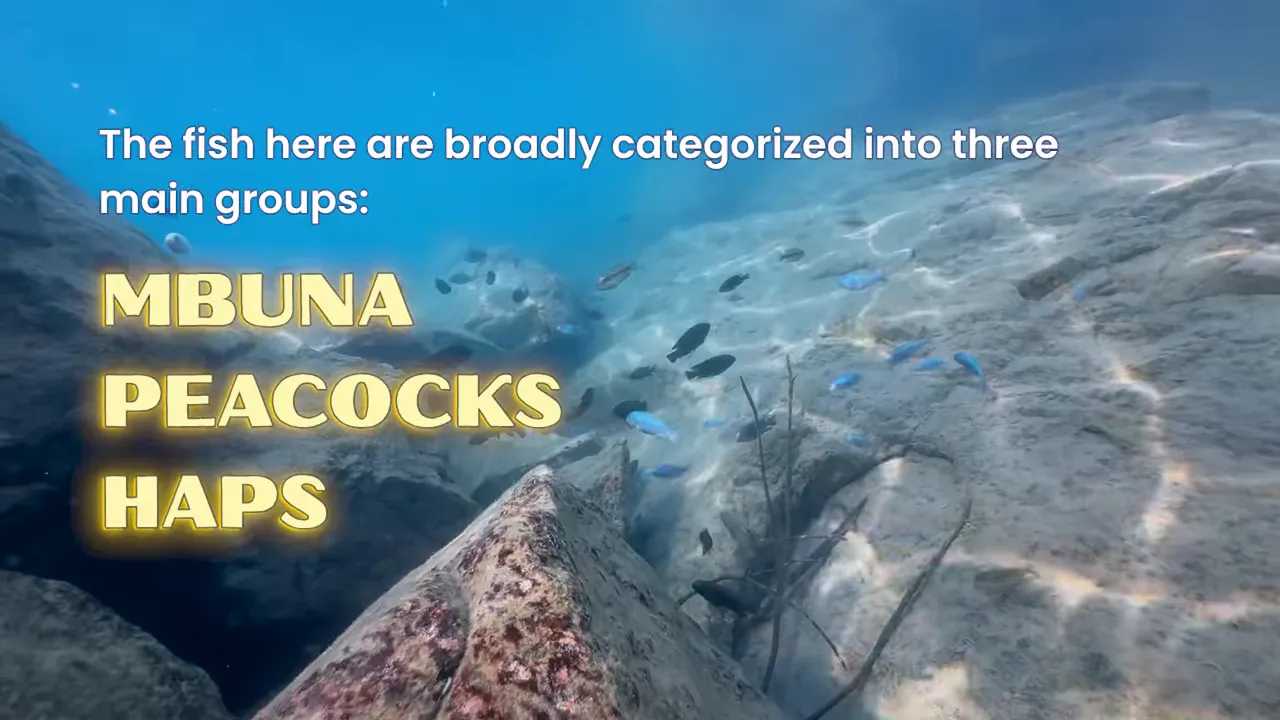
Lake Malawi cichlids are broadly placed into three aquarium groups: Mbuna, peacocks and haps. Although all are Malawi cichlids, they should not be treated as interchangeable.
Mbuna
Mbuna means rockfish. These cichlids live around rocky shoreline habitats and are strongly associated with caves, crevices and territories. They are usually robust, relatively compact in shape and often show vivid colour while still young.
Key traits of Mbuna:
- More aggressive and territorial than the other main groups
- Need extensive rockwork, hiding spaces and broken sight lines
- Require a vegetable-heavy omnivorous diet
- Need a minimum aquarium size of 55 gallons
- Are commonly kept in a deliberately fuller stocking arrangement to help spread territorial aggression
Overstocking in this context does not mean neglecting water quality. A fuller Mbuna tank produces a significant bioload, so filtration and frequent water changes are essential.
Peacock cichlids
Peacock cichlids are open-water swimmers that generally grow larger than Mbuna and tend to be less aggressive. Their colours can be exceptional, though males may take longer to develop full adult colour.
Compared with Mbuna, peacocks usually have a longer, more streamlined body. They benefit from open swimming space with rockwork used as structure rather than allowing décor to fill the whole aquarium.
Hap cichlids
Haps, short for haplochromine cichlids in the aquarium trade, also favour open water and have an elongated, torpedo-like form. Like peacocks, they generally become larger than Mbuna and are usually less aggressive.
Peacocks and haps need a minimum of 75 gallons, with 125 gallons or more being a stronger long-term option. Their lower aggression means purposeful overstocking is not necessary.
Should you mix Mbuna, peacocks and haps?
As a general rule, do not combine all three groups in one aquarium. Their dietary requirements, adult size, activity patterns and aggression levels differ too much for this to be a reliable beginner setup.
Mbuna can be especially problematic alongside peacocks and haps because they are more territorial and require a more plant-based diet. Peacocks and haps also need more open water and tend to grow larger.
A better approach is to build the aquarium around a single group:
- Mbuna tank: dense rockwork, many retreats, broken lines of sight and vegetable-based foods.
- Peacock or hap tank: larger aquarium, more open swimming room, strategic rockwork and a protein-rich feeding approach.
Malawi cichlid tank size and stocking approach
Tank volume is one of the most important welfare considerations for Malawi cichlids. A tank that is too small leaves fish with no room to escape conflict and makes water quality harder to maintain.
| Group | Minimum tank size | Preferred layout | Stocking approach |
|---|---|---|---|
| Mbuna | 55 gallons | Heavy rockwork, caves and visual barriers | A fuller stocking approach can help disperse aggression |
| Peacocks | 75 gallons | Open swimming room with rockwork | Do not rely on overstocking |
| Haps | 75 gallons | Open swimming room with rockwork | Do not rely on overstocking |
For peacocks and haps, 125 gallons or more gives larger fish the room they need and provides more flexibility as the fish mature.
Stocking should also account for sex ratios. An incorrect male-to-female ratio can concentrate attention on a few fish, increase stress and trigger further aggression. Research the needs of each intended species rather than choosing fish by colour alone.
How to set up a Lake Malawi cichlid aquarium
Use rockwork to create territories and escape routes
All Malawi cichlids benefit from rockwork, hiding places and a sandy substrate. For Mbuna, rocks are a central part of the habitat because they create territories and places to retreat. Build stable structures that provide multiple openings and avoid arrangements that trap a weaker fish in a dead end.
Decor should interrupt long, uninterrupted sight lines. If one dominant fish can see and pursue another across the entire aquarium, aggression can become constant.
Peacocks and haps still need rockwork and cover, but their layout should preserve a substantial open area for swimming.
Choose a practical substrate
Sand is a suitable substrate choice for Malawi cichlid aquariums. Some keepers use aragonite sand or dedicated African cichlid substrates to help raise and support pH.
Plants are often a poor fit because cichlids may uproot, eat or damage them. If plants are included, expect them to be disturbed and choose the aquarium layout around the fish rather than relying on delicate planting.
Be cautious with driftwood
Driftwood is sometimes used in Malawi cichlid aquariums, but some keepers avoid it because it may lower pH. This matters in a tank intended for hard, alkaline water. If driftwood is used, monitor water parameters consistently rather than assuming the setup remains stable.
Ideal Lake Malawi cichlid water parameters
Malawi cichlids thrive in warm, hard and alkaline water. The following aquarium targets provide a useful framework:
- pH: 7.8 to 8.6
- General hardness, GH: 10 to 15 dH
- Carbonate hardness, KH: 10 to 12 dH
- Temperature: 72 to 82°F
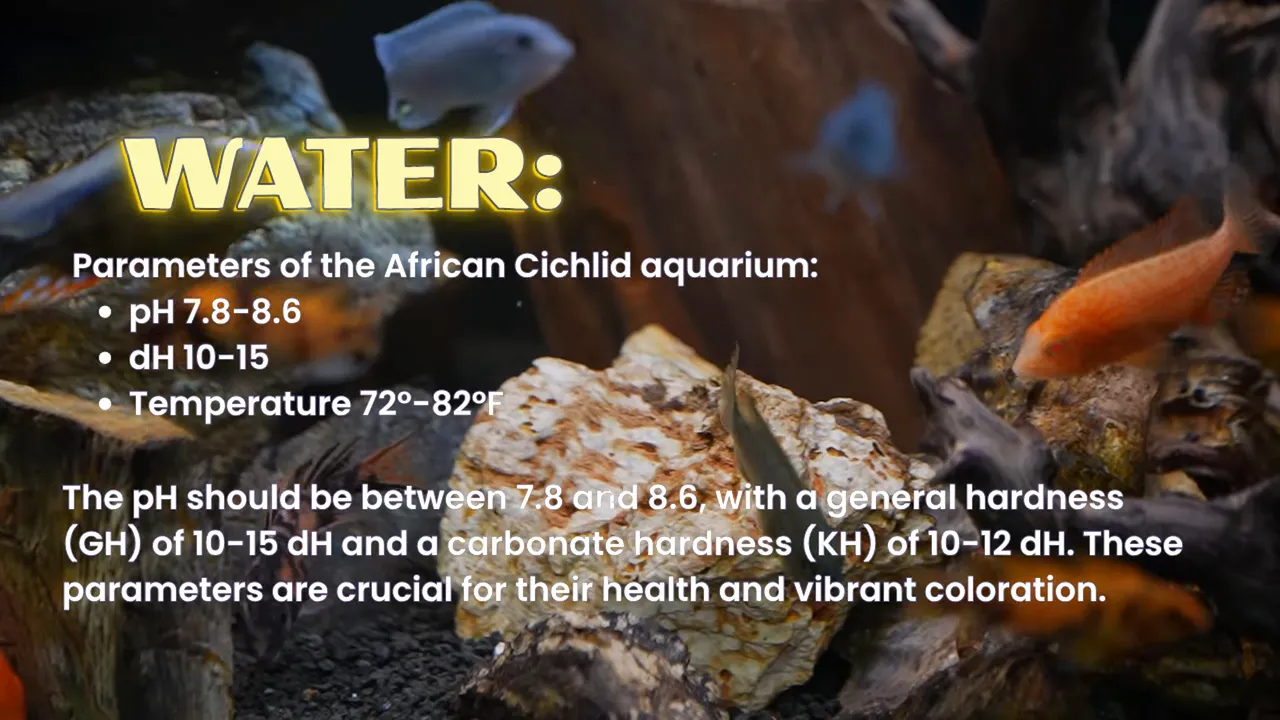
These numbers are useful targets, but consistent water quality matters most. Local tap water may already be sufficiently hard, so test it regularly before making adjustments. Avoid unnecessary chemical changes when your source water already meets the fish's needs.
Malawi cichlids can create a large bioload, particularly in fuller Mbuna setups. Frequent water changes are therefore a core part of maintenance, not an optional extra.
What do Malawi cichlids eat?
Malawi cichlids are generally omnivorous, but diet must match the group being kept. Feeding every Malawi cichlid the same food is a common and potentially dangerous mistake.
Mbuna diet
Mbuna need a higher proportion of vegetable matter. Suitable food choices include spirulina flakes, algae wafers and other plant-forward prepared foods.
Too much protein or excessive feeding can contribute to Malawi bloat, a condition that can be fatal. A Mbuna tank should not be fed as though it contains peacocks or haps.
Peacock and hap diet
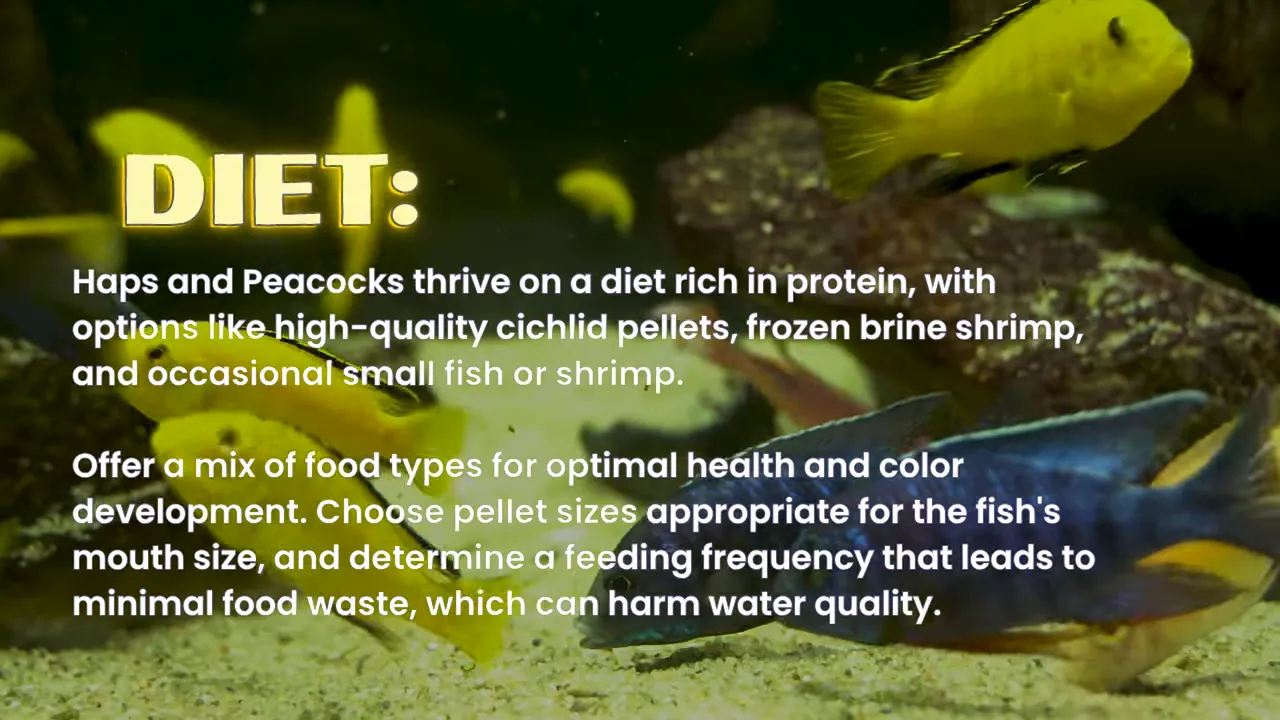
Peacocks and haps do well on a protein-rich diet. High-quality prepared cichlid pellets can be used as a staple, with frozen brine shrimp, mysis and occasional small fish or shrimp as dietary variety.
Offer a mix of suitable food types to support health and colour development. Feed according to the fish's size and reduce wasted food, since excess food damages water quality.
Malawi cichlid behaviour and breeding
Many Malawi cichlid mothers are mouthbrooders. After spawning, the female carries eggs and fry in her mouth, providing protection during early development.
This behaviour is one reason sex ratios matter. Persistent male attention can create severe stress for females in an unsuitable setup. Adequate space, compatible species choices, visual barriers and appropriate male-to-female ratios all reduce the likelihood of ongoing harassment.
Common Malawi cichlid mistakes to avoid
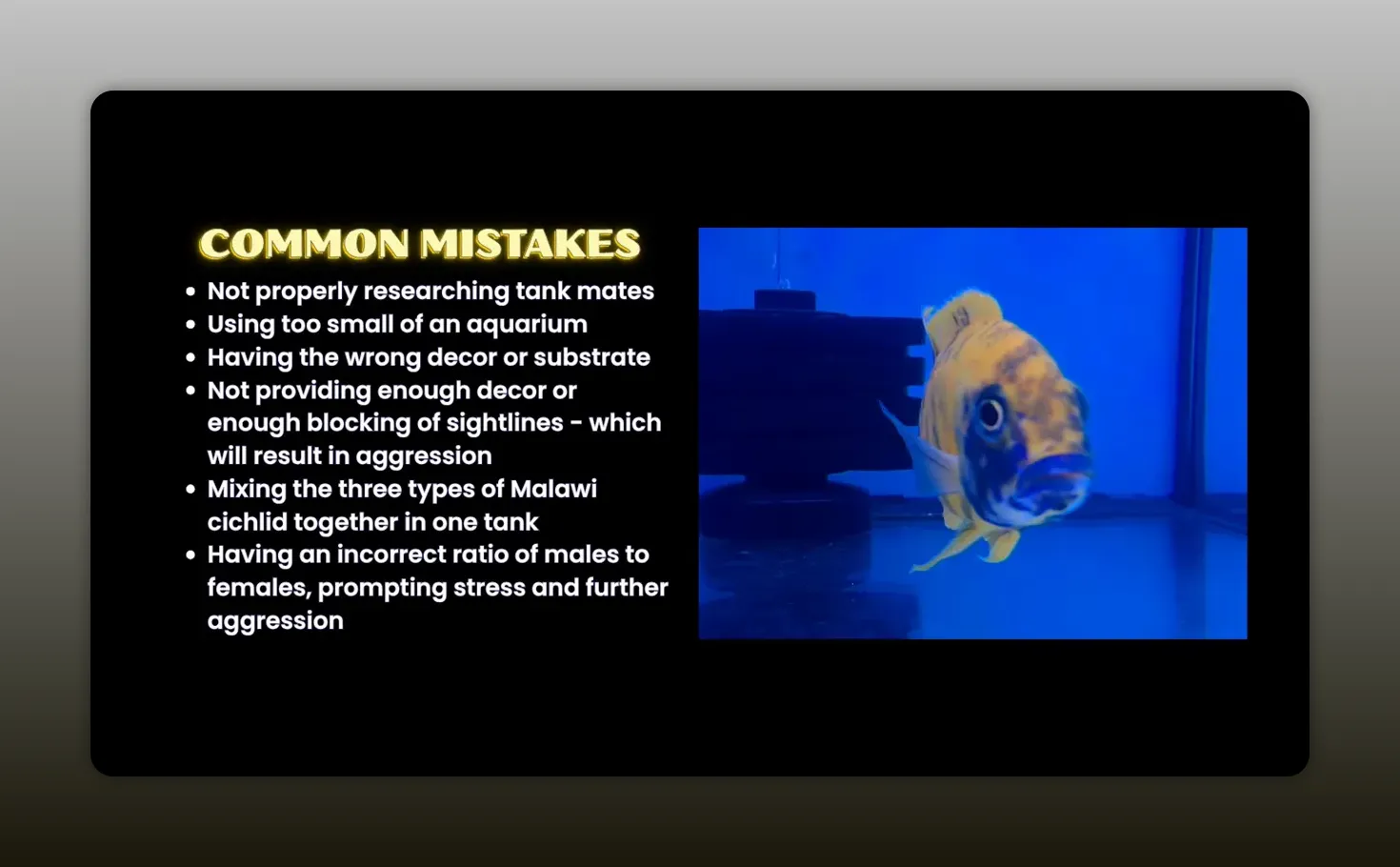
- Choosing tank mates without research. Different Malawi groups have distinct behaviour, size and diet needs.
- Using an aquarium that is too small. Limited space worsens territorial disputes and reduces water-quality stability.
- Mixing Mbuna, peacocks and haps. Their care requirements and aggression patterns do not align well.
- Providing too little décor. Fish need cover, visual barriers and routes away from dominant tank mates.
- Using the wrong décor layout. Mbuna need more rockwork, while peacocks and haps need open water as well as shelter.
- Ignoring male-to-female ratios. Poor ratios can create stress and ongoing aggression.
- Feeding Mbuna too much protein. Their diet needs more vegetable matter than that of peacocks and haps.
- Neglecting water changes. A heavy bioload means water quality can decline quickly.
A practical Malawi cichlid setup checklist
- Select one main group: Mbuna, peacocks or haps.
- Choose the tank size for adult fish: at least 55 gallons for Mbuna, or at least 75 gallons for peacocks and haps. Larger tanks offer more flexibility.
- Plan the aquascape before stocking: use sand, rockwork, hiding spaces and broken sight lines.
- Keep open water where needed: particularly for peacocks and haps.
- Test tap water: check pH, GH and KH and confirm the water remains stable.
- Match food to the fish group: vegetable-heavy for Mbuna, protein-rich for peacocks and haps.
- Research every species and sex ratio: do this before purchase, not after aggression begins.
- Maintain water quality: account for the tank's bioload with frequent water changes.
Frequently asked questions
Are Lake Malawi cichlids good for beginners?
They can be manageable for a prepared beginner, but they need more planning than a typical mixed community aquarium. Success depends on using a sufficiently large tank, selecting compatible fish from one main group, providing the correct diet and maintaining stable hard, alkaline water.
What size tank do Malawi cichlids need?
Mbuna require a minimum of 55 gallons. Peacocks and haps require at least 75 gallons, while 125 gallons or more is preferable for their larger adult size and need for open swimming space.
Can Mbuna live with peacocks and haps?
It is generally best not to mix them. Mbuna are more aggressive, need denser rockwork and require more vegetable matter in their diet. Peacocks and haps are larger, more open-water oriented and benefit from a more protein-rich diet.
What pH do Malawi cichlids need?
A pH of 7.8 to 8.6 is an appropriate target range. They also do best in hard water, with GH around 10 to 15 dH and KH around 10 to 12 dH.
Do Malawi cichlids need rocks?
Yes. Rocks, hiding places and visual barriers are important for all Malawi cichlids. They are especially important for territorial Mbuna, while peacocks and haps need rockwork balanced with plenty of open swimming room.
What causes Malawi bloat?
For Mbuna, an unsuitable diet that is too high in protein, along with overfeeding, can contribute to Malawi bloat. Feed them a diet with a higher proportion of vegetable matter, including spirulina-based foods and algae wafers.
Key takeaway
The best Lake Malawi cichlid aquarium is designed around the needs of one compatible group. Give Mbuna a rock-heavy, vegetable-focused setup, or give peacocks and haps a larger aquarium with open swimming space and a protein-rich diet. Stable alkaline water, appropriate stocking, thoughtful sex ratios and frequent water changes form the foundation for healthy, colourful fish.