Monte Carlo can turn from a compact carpet plant into a thick, cascading mass surprisingly quickly. Regular trimming keeps it healthy, preserves the shape of your aquascape and gives you fresh cuttings for new carpets or hardscape plantings.
The same principle applies across a planted aquarium: remove declining leaves, protect plant rhizomes, give rooted plants access to nutrients and make maintenance easy enough to do consistently. This guide covers practical care for Monte Carlo, Java fern, Anubias, crypts, floating plants and aquarium-supported hydroponics.
Table of Contents
- What makes Monte Carlo useful in a planted aquarium?
- How to trim Monte Carlo without filling the aquarium with clippings
- How to collect loose leaves after trimming
- Java fern care: trim leaves, not the rhizome
- How to attach Anubias to rocks and wood
- Growing crypts and other rooted plants in gravel
- Use floating plants to create cover for guppies
- Lighting, flow and filtration for easy planted tanks
- Try an above-tank aquaponics garden
- Common planted aquarium maintenance mistakes
- Simple planted aquarium maintenance checklist
- Key takeaway
- Frequently asked questions
What makes Monte Carlo useful in a planted aquarium?
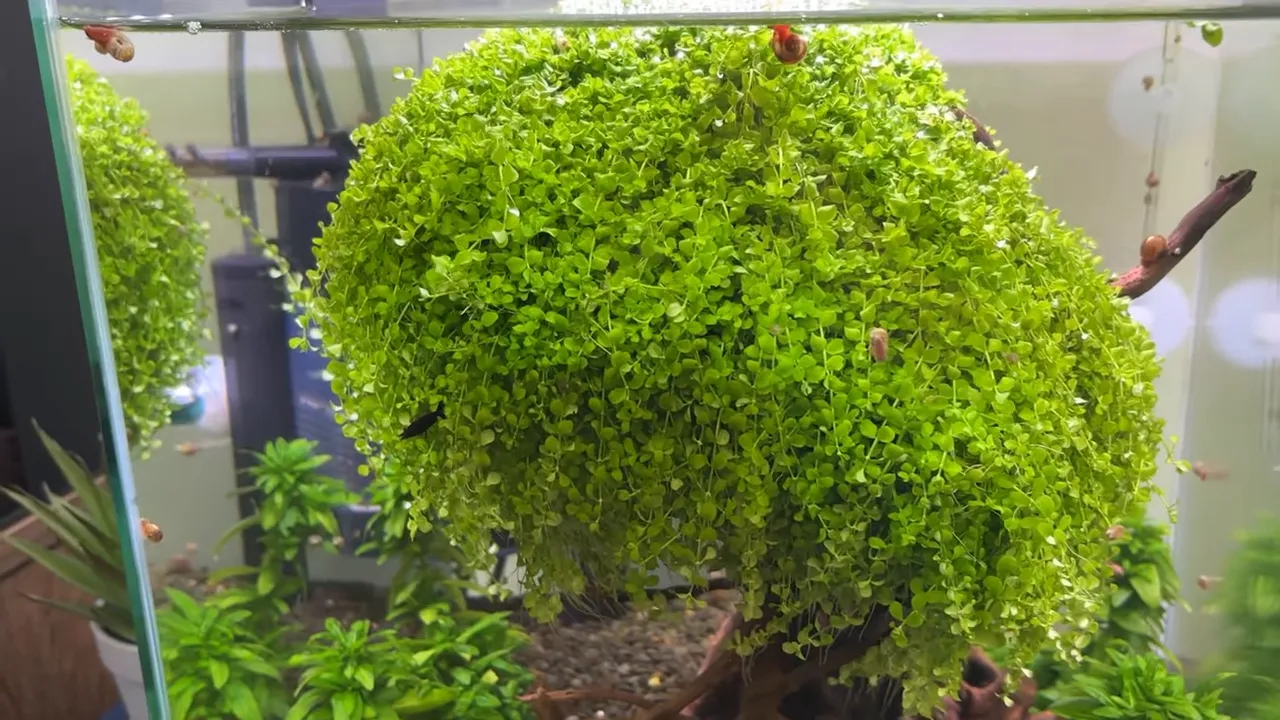
Monte Carlo is a versatile aquarium plant that can be grown as a foreground carpet or attached to hardscape for a rounded, trailing effect. When secured to spider wood, it can develop into a dense green canopy with long hanging growth beneath it.
It can grow well under relatively modest lighting, although a setup with added CO2 can support strong growth. As it thickens, routine pruning becomes important. An overgrown clump can block access to the substrate, collect debris and become difficult to shape.
How to trim Monte Carlo without filling the aquarium with clippings
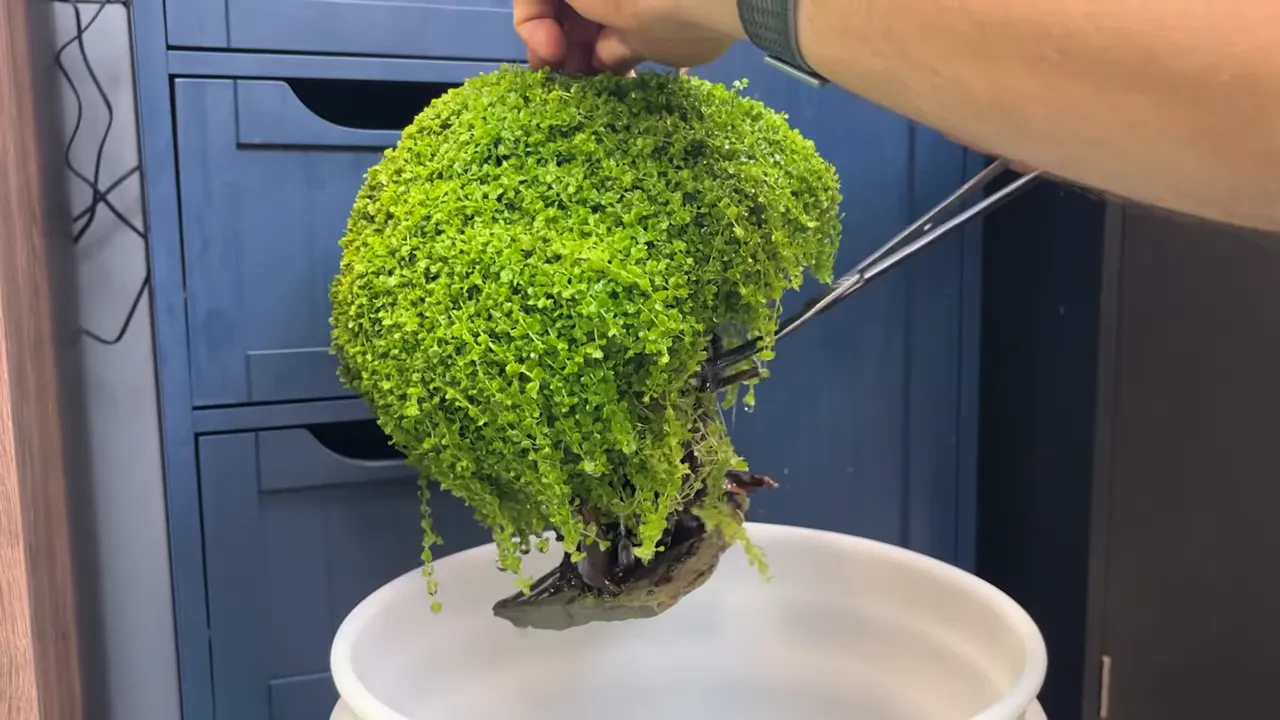
The cleanest approach is to make the planted hardscape removable from the beginning. If the Monte Carlo is tied to wood or another movable feature, the entire piece can be lifted out and trimmed over a bucket.
1. Check the clump before removing it
Look carefully for animals that may be resting in the plant mass, including snails. Gently dislodge them before lifting the hardscape out of the aquarium.
2. Trim over a bucket
Use curved aquarium scissors and hold the plant over a bucket. Trim the hanging lower growth first, removing enough material to reopen space for fresh growth. A rounded, even trim is a simple way to restore the desired shape.
Trimming outside the aquarium prevents thousands of tiny leaves from spreading through the water column, where they can create unnecessary cleanup work.
3. Avoid cutting deeply into the oldest, thickest section
Very dense upper growth may not recover as strongly after a deep cut and can brown back. Rather than cutting aggressively into that older core, focus most pruning on the trailing underside and outer edges. This preserves the established plant mass while making room for new growth.
4. Replant the trimmings
Healthy Monte Carlo cuttings do not need to go to waste. Plant small portions into the substrate to begin a new carpet, or attach them to another suitable piece of wood or rock. A mature clump can become a reliable ongoing source of planting material.
5. Return the hardscape and complete regular maintenance
Once the clump is back in place, the opened-up aquarium is easier to access for a water change, substrate vacuuming and general cleanup. If the plant begins reaching the water surface, it can be gently secured lower with string rather than repeatedly cutting into its oldest growth.
How to collect loose leaves after trimming
Small leaves often gather at the surface after plant maintenance. A simple glass or plastic cup can remove them efficiently. Submerge the cup at the surface so the water movement draws floating leaves into it, then lift the cup out and discard the debris.
This is especially useful around fine-leaved plants and surface-hugging growth, where netting individual fragments can be frustrating.
Java fern care: trim leaves, not the rhizome
Java fern is an easy, adaptable plant that can spread across rock and wood over time. Its thick horizontal stem is called the rhizome. Leaves grow upward from it, while roots grow downward and attach the plant to hardscape.
With ordinary aquarium lighting, clean water and time, Java fern can form a substantial cluster. CO2 is not required for this type of growth.
How to prune Java fern
Remove leaves that are blackening, melting or taking up too much space. Follow each unwanted leaf down to its base and cut it as close to the rhizome as practical. This thins the plant while leaving the rhizome intact to continue producing new leaves.
Do not cut through or bury the rhizome. The rhizome is the plant’s central growing structure. Treat it as the part that must remain exposed and undamaged.
How to attach Anubias to rocks and wood
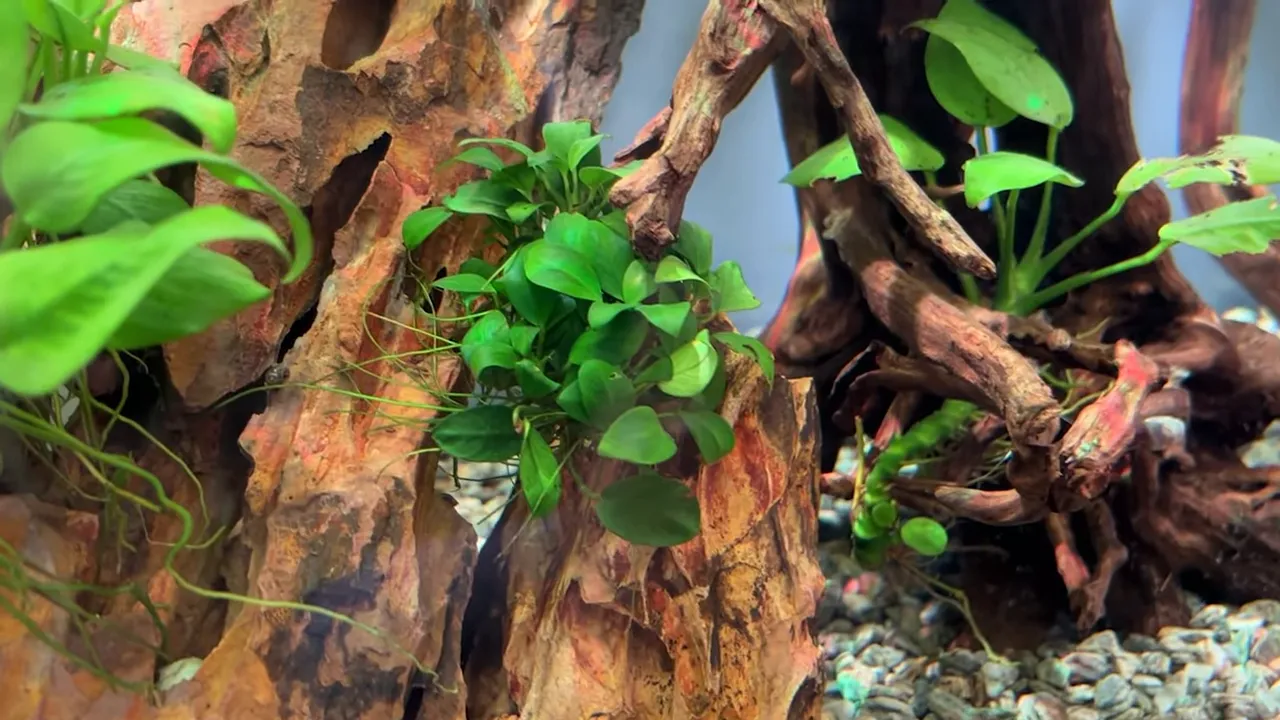
Anubias is another reliable plant for hardscape layouts. It can be attached to rocks, driftwood and other decor, allowing the roots to grip the surface over time.
A thick cyanoacrylate super glue is useful because it stays where it is placed instead of running across the plant or hardscape. Apply a small amount to a root area or attachment point, then press the plant into position.
The critical rule is the same as with Java fern: keep the rhizome uncovered. Do not glue over the thick rhizome, and do not bury it beneath gravel. Covering this portion can damage the plant.
Combine Anubias varieties for contrast
Different varieties can create a layered appearance without demanding complicated care:
- Anubias nana petite: A compact option suited to small gaps and pockets in dragon stone or wood.
- Anubias golden: A lighter green variety that adds colour contrast.
- Anubias barteri: A larger-leaved choice for more substantial focal areas.
Growing crypts and other rooted plants in gravel
Gravel does not have to prevent rooted aquarium plants from growing. Crypts can be planted in gravel when nutrients are supplied at the root zone with root tabs.
Place root tabs in the gravel near the plant roots rather than leaving them on the surface. This provides nutrients where rooted plants can use them and helps support tissue-cultured plants that need to establish in an inert substrate.
Use floating plants to create cover for guppies
Floating and hanging plants can be particularly useful in aquariums with guppies. Their trailing roots create shelter for fry, giving very small fish places to hide from larger fish, including adult guppies.
A sponge filter is also a practical filtration choice in a guppy aquarium. It provides filtration without the same intake concerns posed by some stronger filters, while plant roots add visual cover near the surface.
Lighting, flow and filtration for easy planted tanks
Most low-maintenance planted aquariums benefit from consistent, even illumination and stable water movement. The goal is not necessarily high-intensity lighting, but enough usable light across the aquarium for the chosen plants.
On long aquariums, a light that provides broad coverage can reduce shadowed areas. Surface movement from a hang-on-back filter can also help prevent oily film from accumulating at the water line.
Choose filtration based on the aquarium’s inhabitants and layout:
- Hang-on-back filters: Straightforward to maintain and able to create useful surface flow.
- Sponge filters: A strong option for guppies and other situations where gentle filtration is useful.
- Screen lids: Worth considering for fish that jump, including bettas.
Try an above-tank aquaponics garden
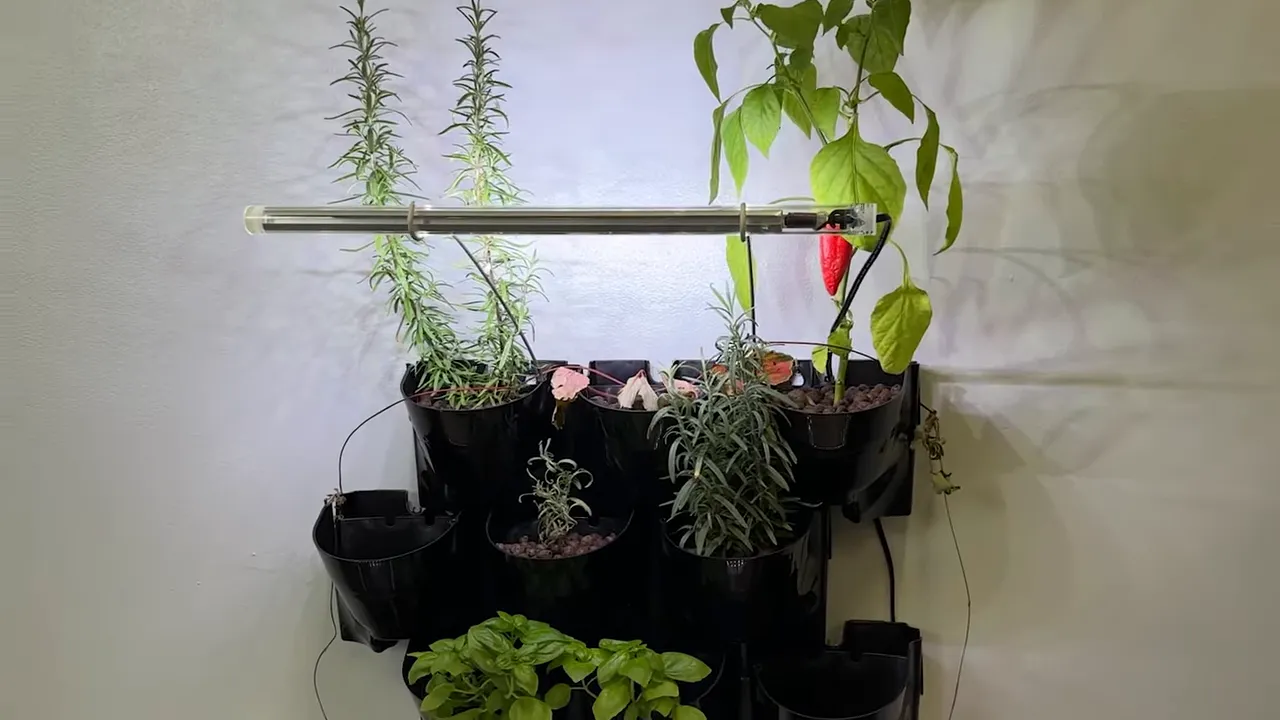
Aquaponic planters provide an alternative way to use aquarium water for plant growth. Water is pumped from the aquarium to an elevated planting system, flows through the planter and returns to the tank.
In this arrangement, nutrients produced in the aquarium, including nitrates associated with fish waste, can support terrestrial plants. Expanded clay balls, often called LECA, are useful growing media because water can move freely through them.
Herbs, strawberries, peppers and other plants may be grown in this kind of modular system, provided the setup is designed to return water safely to the aquarium and is maintained as part of the overall system.
Common planted aquarium maintenance mistakes
- Trimming Monte Carlo in the tank: Fine cuttings can spread everywhere. Remove detachable hardscape and trim over a bucket when possible.
- Cutting too deeply into mature Monte Carlo: The oldest, densest growth may brown or recover poorly after a hard cut.
- Burying Java fern or Anubias rhizomes: These plants should be attached with the rhizome exposed, not planted like rooted substrate plants.
- Leaving declining Java fern leaves in place: Cut damaged leaves at their base to improve the plant’s appearance and open space.
- Ignoring surface debris: Use a small cup to capture loose floating leaves before they circulate through the aquarium.
- Providing no root nutrition for gravel-planted crypts: Root tabs help make inert gravel workable for rooted plants.
- Overlooking fish safety at the surface: Use a secure screen lid for jump-prone fish and provide cover for fry where appropriate.
Simple planted aquarium maintenance checklist
- Inspect plants: Identify overgrown areas, declining leaves and loose debris.
- Remove detachable hardscape: Lift out Monte Carlo-covered wood or rocks before major trimming.
- Prune strategically: Shape Monte Carlo from the lower growth; remove individual Java fern leaves at the base.
- Save viable cuttings: Replant Monte Carlo trimmings for new carpet sections.
- Clean the surface: Collect small floating fragments with a cup.
- Perform a water change and vacuum accessible areas: Maintenance is easier after dense hardscape is temporarily removed.
- Check roots and rhizomes: Confirm Anubias and Java fern rhizomes remain exposed and securely attached.
- Review equipment: Ensure filtration creates suitable flow and any lid is properly fitted.
Key takeaway
Healthy planted aquariums do not need to be perfectly manicured, but they do benefit from intentional maintenance. Trim Monte Carlo outside the aquarium when possible, preserve the rhizomes of Java fern and Anubias, feed rooted plants with root tabs and use plant cover to support the needs of your fish. These small habits keep an aquascape attractive, accessible and easier to maintain over time.
Frequently asked questions
Can you trim Monte Carlo aggressively?
You can remove a substantial amount of trailing Monte Carlo growth, especially from the underside and outer shape. Avoid deep cuts into the oldest, thickest portion of the plant, as it may brown or regrow less strongly.
Can Monte Carlo cuttings be replanted?
Yes. Trimmed Monte Carlo can be planted into the substrate to establish a new carpet or used on another piece of hardscape.
Should Java fern be planted in gravel?
Java fern is best attached to rock or wood with its rhizome exposed. It can spread along hardscape as its roots attach over time.
Can Anubias be glued to aquarium decor?
Yes. A small amount of thick super glue can attach Anubias to rock or wood. Keep glue off the rhizome and do not bury the rhizome under substrate.
Do crypts grow in gravel?
Crypts can grow in gravel when root tabs are placed in the substrate to provide nutrients near their roots.