Reliable water testing is one of the most useful habits for maintaining a healthy freshwater aquarium. The NT Labs Aquarium Lab Multi Test Kit is an all in one liquid testing kit for checking six core water parameters: ammonia, nitrite, nitrate, pH, general hardness (GH), and carbonate hardness (KH).
For fishkeepers dealing with unexplained fish stress, algae, poor plant growth, or a newly established tank, these results help identify whether water chemistry or the nitrogen cycle could be contributing to the problem.
Table of Contents
- Is the NT Labs Aquarium Test Kit Accurate?
- What Does the NT Labs Multi Test Kit Measure?
- How to Test Aquarium Water With a Liquid Test Kit
- Why Tracking Aquarium Test Results Matters
- When Should You Test Your Freshwater Aquarium Water?
- Common Aquarium Water Testing Mistakes
- Liquid Test Kit Versus Test Strips
- Key Takeaway
- Frequently Asked Questions
Is the NT Labs Aquarium Test Kit Accurate?
The NT Labs Multi Test Kit uses liquid reagents and colour comparison charts to produce repeatable readings when each test is performed according to its instructions. Liquid tests provide a more deliberate way to assess aquarium water than relying on a quick visual estimate, particularly when troubleshooting a tank issue.
Accuracy depends on following the individual test instructions carefully. Each parameter has its own reagent, process, and colour scale. Use the correct sample volume, add the stated number of drops, mix as directed, and compare the developed colour with the supplied chart.
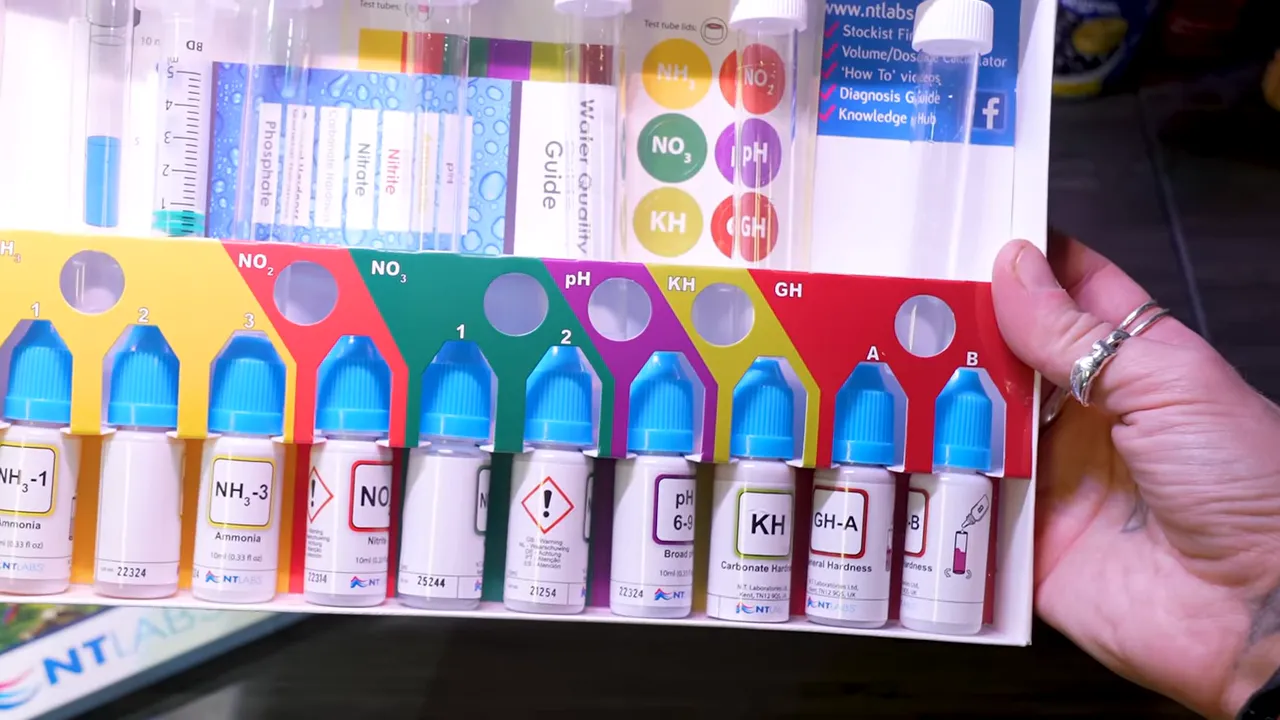
The kit is designed for freshwater aquariums and includes enough reagents for nearly 200 tests. Its organised layout, labelled test tubes, illustrated instructions, and test log make routine monitoring easier to repeat consistently.
What Does the NT Labs Multi Test Kit Measure?
The six included tests cover the most important water quality measures for a freshwater tank. Some identify harmful nitrogen waste, while others explain the water chemistry that affects fish, plants, and pH stability.
Ammonia
Ammonia is a major waste product associated with feeding fish. Uneaten food, decaying plant matter, and other organic material can also contribute to it. It is highly toxic to fish, so an ammonia result is an important warning sign that the aquarium may not be processing waste effectively.
Beneficial bacteria convert ammonia into nitrite as part of the aquarium nitrogen cycle.
Nitrite
Nitrite is the next stage of waste processing. It is produced when beneficial bacteria break down ammonia. Although it is less toxic than ammonia, nitrite is still harmful to fish and should be monitored closely, especially in a tank that is cycling or experiencing a problem.
Nitrate
Nitrate is produced after beneficial bacteria process ammonia and nitrite. It is generally less harmful to fish than those earlier nitrogen compounds, but excessive nitrate can still create problems.
In planted aquariums, nitrate is also a plant nutrient. Very high levels may be associated with excessive algae and can affect plant growth. Checking nitrate regularly provides a useful picture of the waste load in the tank.
pH
pH measures whether aquarium water is acidic or alkaline. The scale runs from 0 to 14, with lower values being more acidic and higher values being more alkaline. A value of 7 is neutral.
The appropriate pH depends on the aquarium and its inhabitants. More important than chasing a number is understanding the tank’s baseline and identifying unexpected changes that may affect fish and plants.
Carbonate Hardness, or KH
KH, also called carbonate hardness or total alkalinity, measures the water’s buffering capacity. In practical terms, KH indicates how well the aquarium can resist changes in pH.
Sufficient KH helps protect the system from pH fluctuations. If pH seems unstable, testing KH helps explain why the water may not be holding steady.
General Hardness, or GH
GH measures the dissolved mineral content of the water. Water falls on a spectrum from soft to hard, and higher mineral content means higher general hardness.
Testing GH is especially useful when assessing tap water. Without using reverse osmosis water, lowering GH can be difficult, so knowing the source water’s hardness is an important starting point for managing aquarium chemistry.
How to Test Aquarium Water With a Liquid Test Kit
A full water test does not need to be complicated. The key is to keep the process organised and treat every parameter as a separate test.
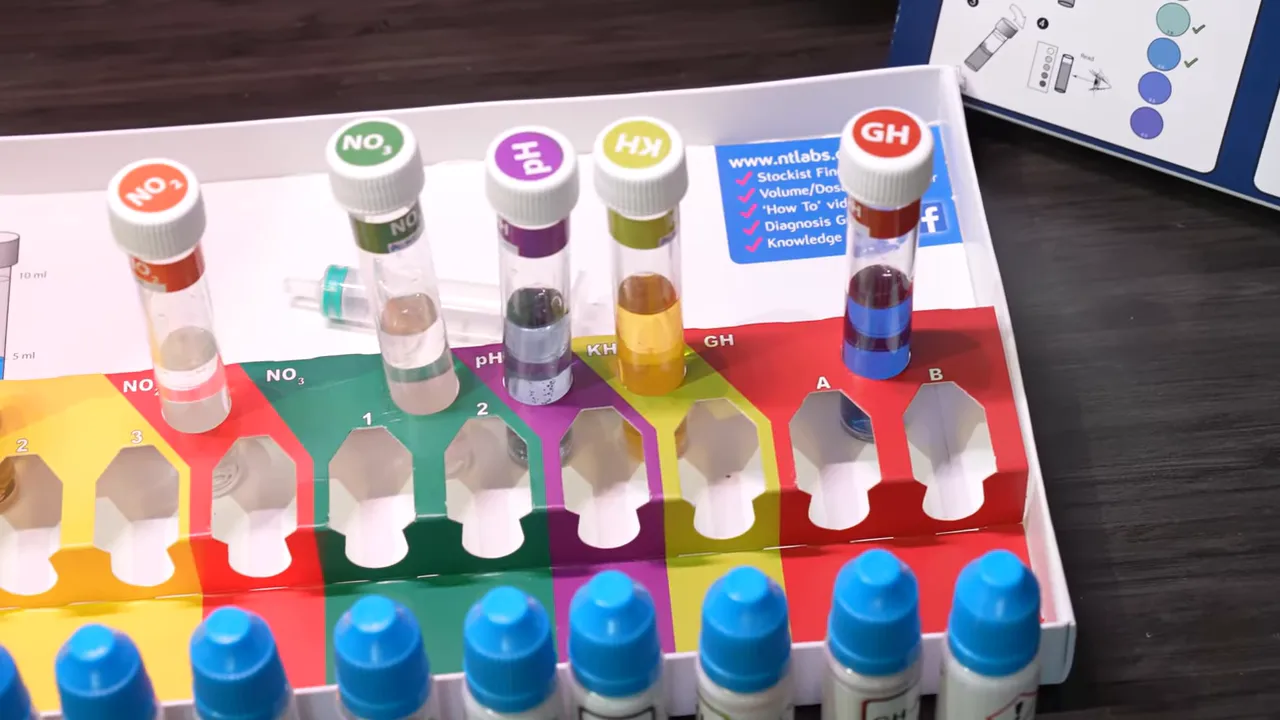
- Set out the equipment. Arrange the test tubes, colour card, reagents, and instructions before collecting water.
- Label each test tube. Use the supplied labels or organised holder so every sample remains associated with the right parameter.
- Collect aquarium water samples. Take the required amount of tank water into each designated tube.
- Follow the instructions for that specific test. Add only the correct reagent and number of drops for ammonia, nitrite, nitrate, pH, KH, or GH.
- Mix as directed. Some tests require swirling or shaking to develop the result properly.
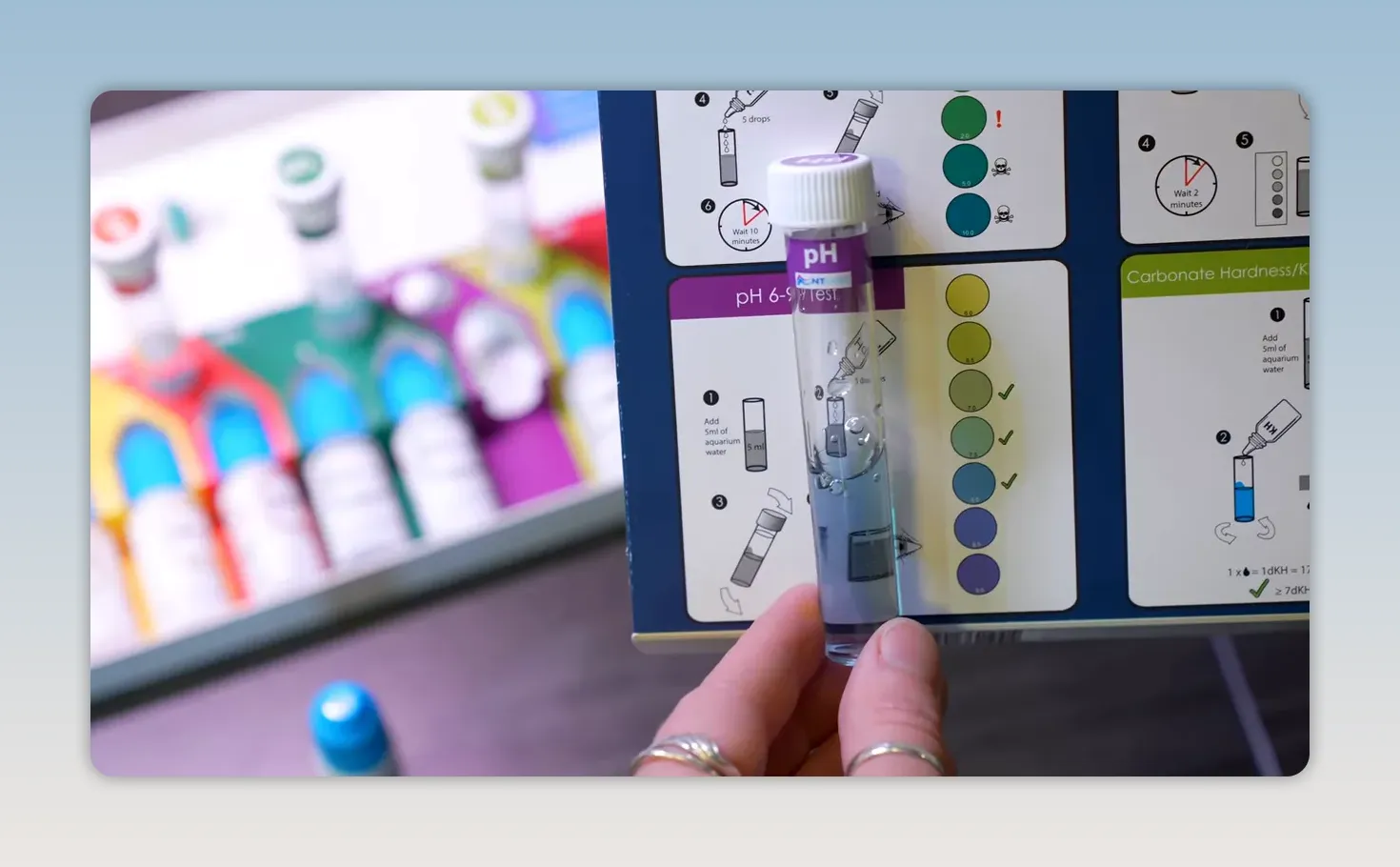
- Compare the sample with the colour chart. Match the final colour to the relevant scale for that parameter.
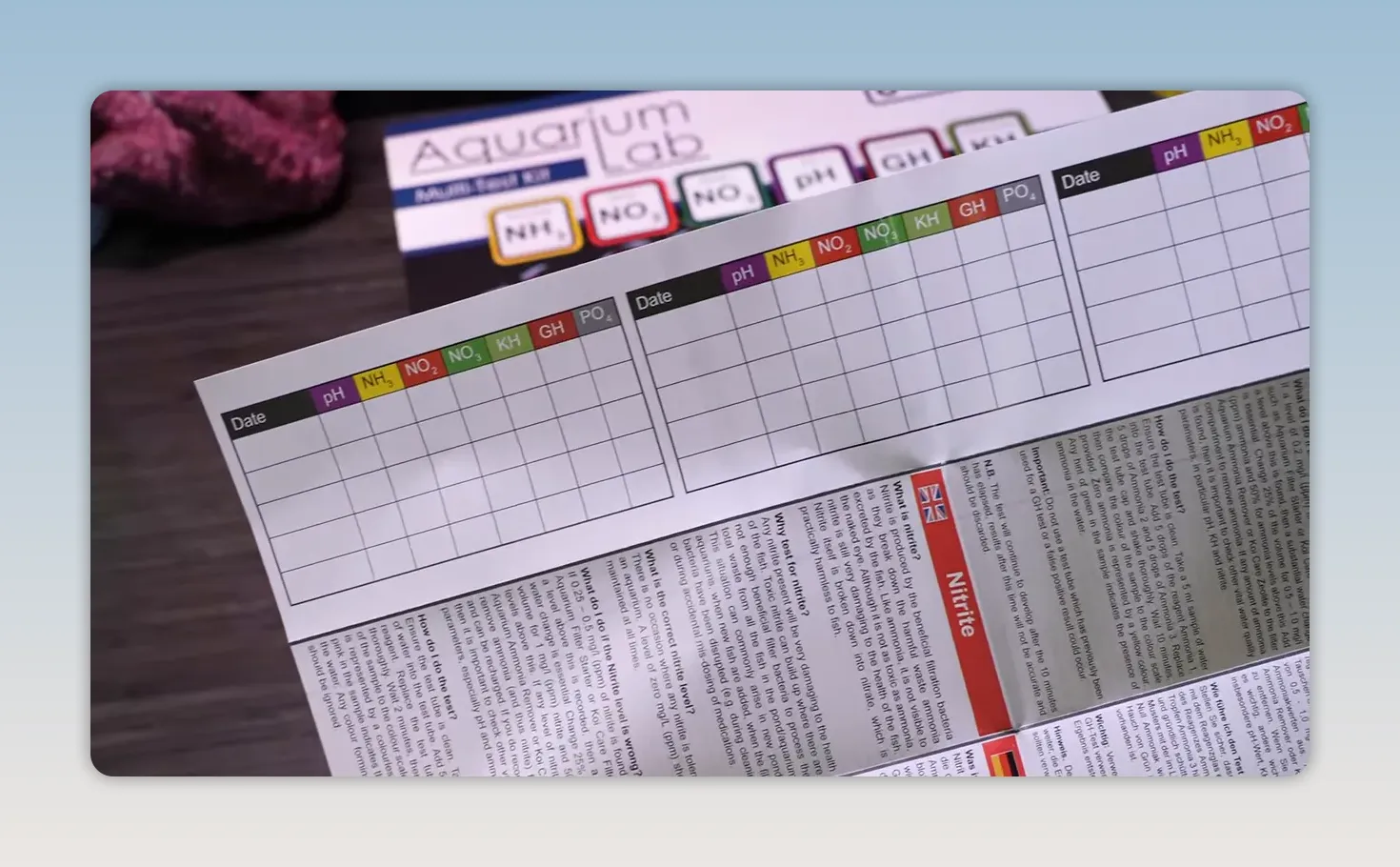
- Record the result. Note the date and result in the supplied calendar or another testing log.
Why Tracking Aquarium Test Results Matters
A single result tells you what the water is like at that moment. A written history helps reveal whether the aquarium is stable, improving, or drifting in the wrong direction.
The included calendar style tracking system is useful for recording results over time. It can help identify patterns such as:
- Ammonia or nitrite appearing after a change in feeding or tank maintenance
- Nitrate gradually rising between water changes
- pH shifting alongside changes in KH
- Differences between aquarium water and tap water hardness
- Recurring conditions linked to algae or plant problems
When Should You Test Your Freshwater Aquarium Water?
Regular testing is useful for routine maintenance, but it becomes especially important when something changes in the aquarium. Test the water when:
- Fish appear unwell or behave unusually
- Aquarium plants are struggling
- Algae becomes excessive
- Uneaten food or decaying leaves are building up
- The tank is newly set up or its biological filtration is still developing
- pH seems to be fluctuating
- You need to understand the hardness of your tap water
Testing ammonia, nitrite, and nitrate together gives a clearer view of how waste is moving through the aquarium. Testing pH, KH, and GH alongside them gives the chemical context needed to understand water stability and mineral content.
Common Aquarium Water Testing Mistakes
Testing only one parameter
A pH result alone cannot show whether a tank has a waste processing problem. Likewise, a nitrate result does not explain whether the water has enough buffering capacity to resist pH swings. Test the complete set when diagnosing an issue.
Ignoring ammonia and nitrite because the water looks clear
Clear water is not proof that ammonia or nitrite are absent. These compounds are connected to fish waste and decaying organic material, so liquid testing is needed to check for them.
Failing to distinguish GH from KH
GH and KH are both forms of hardness, but they answer different questions. GH concerns dissolved minerals, while KH concerns the water’s buffering capacity and its ability to resist pH change.
Not checking tap water GH
If the aquarium uses tap water rather than reverse osmosis water, test the tap water as well. This establishes the hardness entering the aquarium and helps explain why GH may remain high.
Skipping record keeping
Without dates and past readings, it is difficult to tell whether a value is a one time result or part of a developing trend. A simple test calendar creates a much more useful maintenance record.
Liquid Test Kit Versus Test Strips
Test strips can offer a quick indication of water conditions, but a liquid reagent kit is a stronger choice when accurate, repeatable readings matter, particularly while investigating a tank problem. The NT Labs kit provides individual tests for all six core parameters and uses dedicated colour charts and instructions for each one.
For routine freshwater aquarium care, a liquid multi test kit provides a structured way to measure the water conditions that matter most for fish health, plant growth, and pH stability.
Key Takeaway
The NT Labs Aquarium Lab Multi Test Kit provides a practical freshwater testing system for ammonia, nitrite, nitrate, pH, KH, and GH. Its greatest value is not simply obtaining one reading, but using the results together and tracking them over time.
If an aquarium is showing signs of trouble, begin with a complete water test. Check for toxic waste compounds first, then review nitrate, pH, KH, and GH to understand the broader water chemistry.
Frequently Asked Questions
What does the NT Labs Aquarium Lab Multi Test Kit test for?
It tests six freshwater aquarium parameters: ammonia, nitrite, nitrate, pH, general hardness or GH, and carbonate hardness or KH.
Why are ammonia and nitrite important in an aquarium?
Ammonia is highly toxic to fish and is produced from fish waste, feeding, uneaten food, and decaying organic matter. Beneficial bacteria convert ammonia into nitrite, which is also harmful to fish.
What is the difference between GH and KH?
GH measures dissolved minerals and indicates whether water is soft or hard. KH measures buffering capacity, which affects how well the aquarium can resist changes in pH.
Can high nitrate cause problems in a planted aquarium?
Nitrate is a plant nutrient, but excessive levels can cause problems with plant growth and may be associated with excessive algae.
Should tap water be tested for GH?
Yes. Testing tap water GH is useful when tap water is used in the aquarium, because it shows the mineral hardness entering the system. Lowering GH can be difficult without reverse osmosis water.