Monte Carlo can transform driftwood, rocks, and substrate into a dense, bright-green aquascape. Its fast, cascading growth is part of the appeal, but left unmanaged, the plant can become overgrown, collect debris, shade itself, and hide the hardscape that gives the layout its structure.
Regular trimming keeps Micranthemum tweediei ‘Monte Carlo’ compact and healthy-looking. The key is to cut deliberately, stop water flow before starting, and remove loose fragments before they settle in unwanted places.
Table of Contents
- Why Monte Carlo Needs Regular Trimming
- Tools for Trimming Monte Carlo on Wood and Hardscape
- How to Trim Monte Carlo Step by Step
- What a Good Monte Carlo Trim Should Look Like
- Preventing Problems That Can Set Back a Planted Aquascape
- Common Monte Carlo Trimming Mistakes
- Monte Carlo Trimming Checklist
- Final Takeaway
- Frequently Asked Questions
Why Monte Carlo Needs Regular Trimming
Monte Carlo is often used as a carpeting plant, but it also works especially well attached to or growing over spiderwood. In that setting, it can develop a thick, trailing canopy that softens the wood and creates a lush riverbank effect.
As the mass gets thicker, however, it becomes harder for water to move through the plant. A trim restores visual definition and gives the growth more space. Immediately after a heavy cut, the plant may look sparse or uneven, but this is normal. The goal is to create room for fresh, vibrant growth rather than preserve every long strand.
Trimming is most useful when Monte Carlo begins to:
- Cover key branches, rocks, or open spaces in the layout
- Grow into a dense blanket with long hanging strands
- Trap loose organic matter
- Lose the compact shape you intended for the aquascape
- Become difficult to clean around or beneath
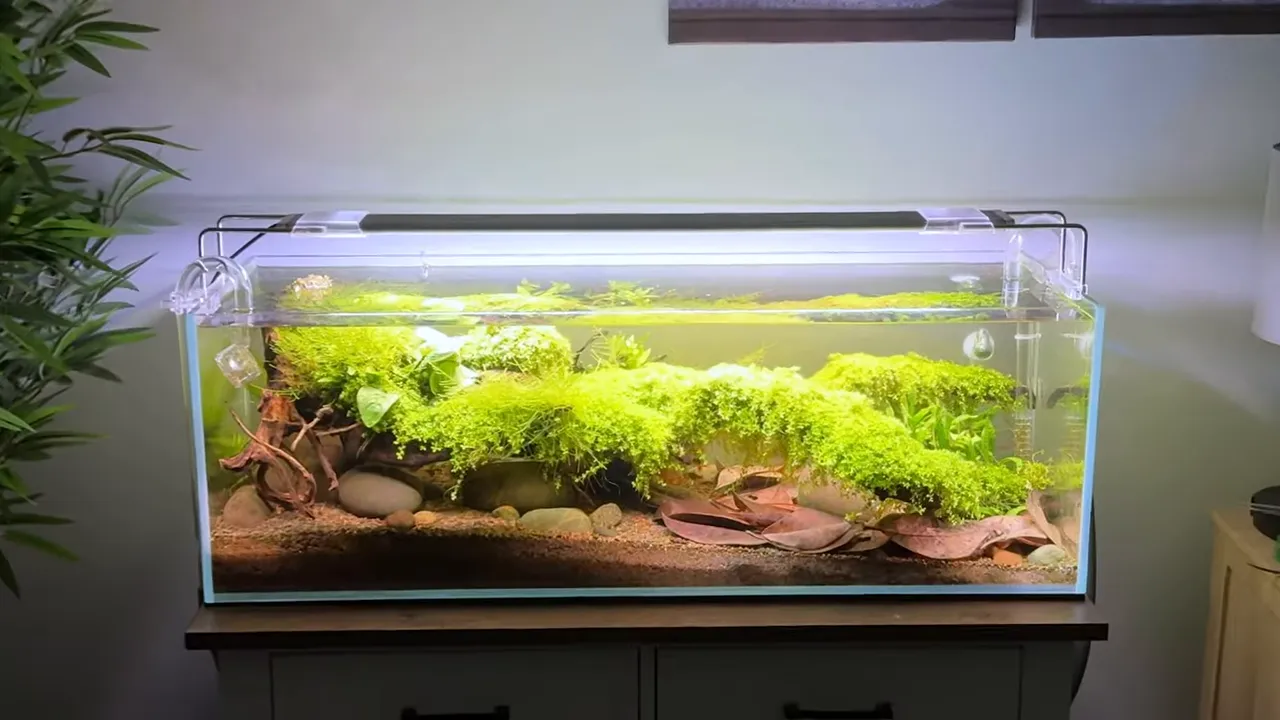
Tools for Trimming Monte Carlo on Wood and Hardscape
The best tool depends on where the growth sits. A planted aquarium with wood branches, overhangs, and tight corners benefits from having more than one scissor shape available.
Spring scissors
Spring scissors are useful for controlled, repetitive snips. They are well suited to small corrections, detail work, and places where the plant needs a light touch rather than a broad cut.
Wave scissors
Wave scissors help reach across uneven terrain. Their shape makes them practical for following the contour of a plant-covered branch or shaping a flowing ridge of Monte Carlo.
Curved scissors
Curved scissors are valuable for reaching underneath and around hardscape. Use them to remove trailing growth from the underside of wood and to maintain a cleaner gap beneath an arch.
Cleanup tools
Have a fine net ready for surface debris. A narrow, clear scoop or similar small tool can also help dislodge tiny pieces caught between wood, equipment, and aquarium corners.
Practical rule: choose the tool that lets you see the cutting line. Do not force a large pair of scissors into a tight gap where it can damage neighbouring plants or snag the wood.
How to Trim Monte Carlo Step by Step
1. Turn off flow and dim the lights
Before cutting, switch off the aquarium’s water flow. This prevents freshly cut pieces from being blown throughout the tank while you work. Dimming the light also makes the maintenance process less disruptive and can make it easier to concentrate on the plant’s outline.
Do not start cutting while strong circulation is carrying fragments into the filter intake, behind hardscape, or across the aquarium.
2. Decide on the finished shape before cutting
Look at the aquascape as a whole first. Decide which areas should remain full and which should be opened to reveal wood, rocks, leaf litter, or swimming space.
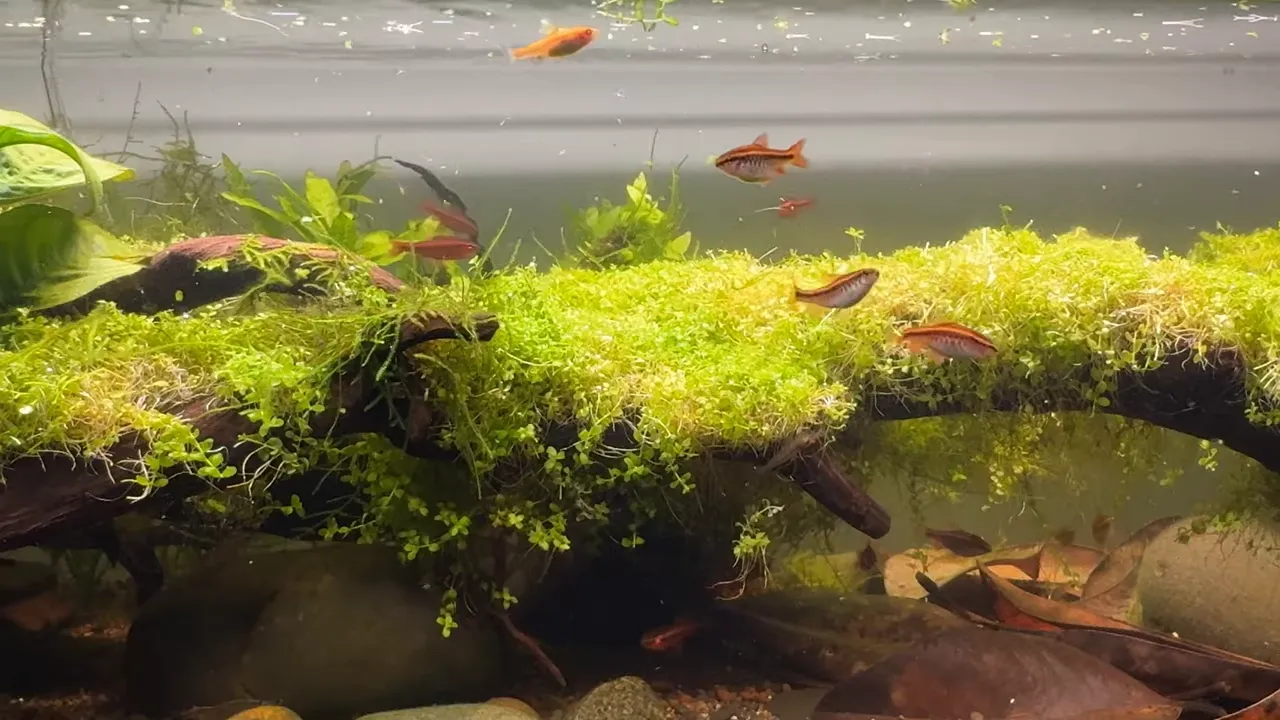
For a cascading Monte Carlo layout, preserve the broad upper surface while reducing excessive length along the edges. Under an arched branch, cut enough to restore the open space beneath it. This helps the wood read as an intentional feature rather than a hidden support for a solid green mass.
3. Trim the top surface gradually
Start with the highest and thickest areas. Make small passes across the surface rather than removing everything in one aggressive cut. Work in the direction of the shape you want, using the scissor curve to follow the contour of the wood.
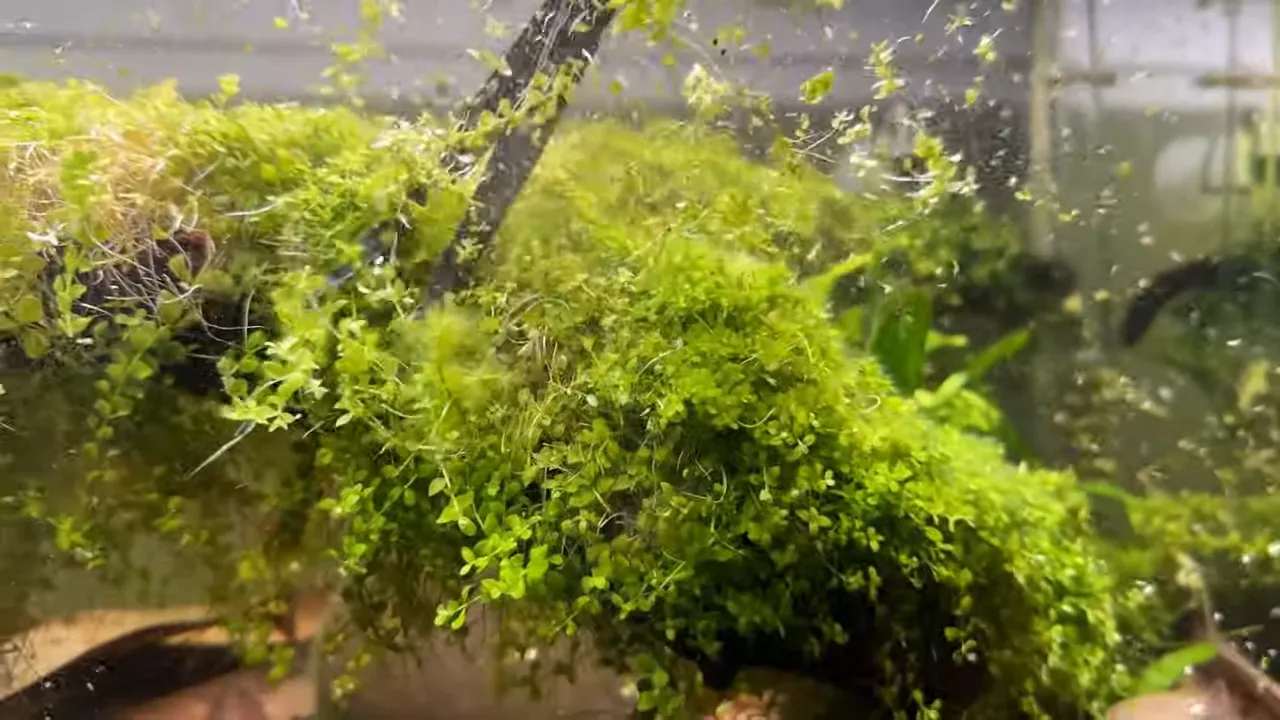
Short, measured cuts give better control than trying to shear a thick clump all at once. If the plant is especially overgrown, expect plenty of loose fragments to rise into the water column.
4. Cut underneath and between branches
Once the main canopy is reduced, use curved or wave scissors to work below the plant mass. Remove growth that blocks the view of the driftwood or hangs too deeply into open areas.
This step is where a planted woodscape regains its depth. Keep enough growth to maintain the natural, soft transition, but clear excessive material so water and sightlines can pass through the layout.
5. Let trimmed pieces float upward
After the main trim, give loose Monte Carlo fragments time to rise to the surface. This makes collection much easier than chasing every piece through the aquarium.
A small amount of plant matter may remain suspended temporarily. Once circulation is restored, the filter can collect some of the fine material. The priority is removing the larger clumps before they become trapped in corners or tangled in the remaining plant mass.
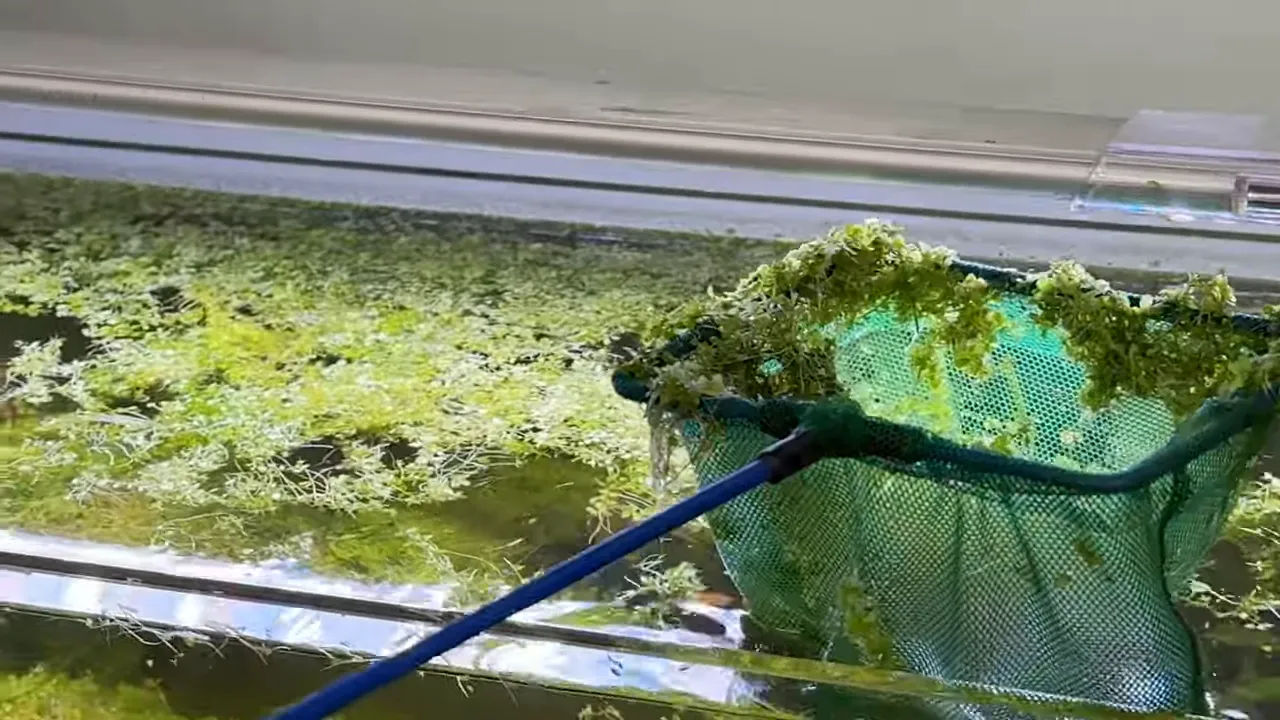
6. Net the surface thoroughly
Skim the surface slowly with a fine net, keeping the collected Monte Carlo close to the top of the water. Work around the aquarium perimeter and revisit areas where fragments accumulate.
For inaccessible corners, gently use a narrow tool to dislodge trapped pieces so they can float up. Avoid stirring the substrate unnecessarily. The aim is to free plant cuttings, not to cloud the entire aquarium.
7. Restore filtration and assess the result
Turn the flow back on after most loose cuttings have been removed. Some temporary water discolouration can occur when trimming stirs organic material into the water column. In the demonstrated maintenance approach, the filter was allowed to clear the remaining suspended debris after a major trim.
Check the tank from the front and from each end. Look for areas that still appear too heavy, bare branches that should retain some cover, and cuttings caught near filtration equipment.
What a Good Monte Carlo Trim Should Look Like
A successful trim does not need to look perfect immediately. Freshly cut Monte Carlo can look thinner, uneven, and less polished than a fully grown canopy. That is expected after removing a large amount of plant material.
Instead, assess whether the trim has achieved these outcomes:
- The hardscape is visible again
- The plant has room to fill in with new growth
- Dense, tangled sections have been reduced
- There is more open space around and under wood
- Most loose fragments have been removed
- The overall layout still has a natural, intentional shape
Preventing Problems That Can Set Back a Planted Aquascape
Overgrowth is manageable, but plant health problems can force a more substantial redesign. A resilient aquascape benefits from stable conditions and a willingness to change the planting plan when a particular approach is not working.
Maintain water movement and oxygenation
Long aquariums can develop low-flow areas. Adding a sponge filter or bubbler can help create surface agitation and improve oxygenation, particularly where circulation is weak.
Pay attention to zones behind large wood structures and dense plant growth. These are the places most likely to become isolated from the main water flow.
Avoid major CO2 interruptions
Carbon dioxide consistency matters in planted tanks using CO2 injection. A significant shift from CO2 being available to unavailable can contribute to cyanobacteria issues. In one aquascape recovery, a CO2 supply interruption combined with a low-flow area preceded a cyanobacteria outbreak that spread across plants, wood, and rocks.
The useful lesson is not that every outbreak has a single cause. It is that stable CO2 and adequate movement are important foundations for a healthy planted aquarium.
Act early when cyanobacteria spreads
Cyanobacteria can overtake surfaces quickly. Treatment may be attempted, but manual removal can become necessary when it has spread broadly across the hardscape and plants. If a layout has been overwhelmed, rebuilding part of the scape can be more practical than trying to preserve every original planting decision.
Recognise failing Anubias before it affects the design
Anubias attached across driftwood can create a striking look, but widespread decline calls for intervention. Warning signs include leaves that yellow and detach, plus roots showing signs that the plant is not recovering.
If decline affects many plants at once, remove the failing material rather than letting it define the entire aquascape. Replanting with a different concept can produce a stronger result than repeatedly trying to rescue a design that is no longer viable.
Common Monte Carlo Trimming Mistakes
Trimming with the flow running
Strong circulation scatters cuttings before they can be collected. Turn flow off first, trim, allow debris to rise, then net it out.
Trying to preserve every strand
Monte Carlo often needs a significant reduction to regain shape and breathing room. A heavy trim can look rough at first, but leaving dense, tangled growth untouched does not solve the maintenance issue.
Ignoring the underside of planted wood
Only trimming the top creates a neat surface while leaving a thick, shaded curtain below. Use curved scissors to clean the underside and maintain the open spaces that give the layout dimension.
Leaving clippings in inaccessible corners
Netting alone may not reach around wood or filtration. Gently dislodge trapped fragments so they rise to the surface, then collect them.
Giving up after a planting plan fails
Aquascapes evolve. A riverbed layout may encounter algae or cyanobacteria. Anubias may not remain viable in a particular setup. Monte Carlo may ultimately become the planting that gives the composition its character. Treat setbacks as information for the next version of the design.
Monte Carlo Trimming Checklist
- Switch off water flow
- Dim the aquarium lights
- Choose spring, wave, or curved scissors for the area
- Plan the silhouette before cutting
- Reduce thick top growth in small passes
- Trim under and around driftwood branches
- Wait for loose clippings to float upward
- Net the surface and clear corners
- Restore filtration
- Recheck the aquascape once debris begins to clear
Final Takeaway
Trimming Monte Carlo is not simply a cosmetic task. It is how you maintain the shape, openness, and long-term appeal of a planted aquascape. Use the right scissor for the location, stop circulation before cutting, remove clippings methodically, and accept that a major trim may look temporarily sparse.
With regular shaping and stable aquarium conditions, Monte Carlo can continue to grow into a dense, bright green feature without swallowing the aquascape beneath it.
Frequently Asked Questions
How often should Monte Carlo be trimmed?
Trim Monte Carlo when it becomes thick enough to hide hardscape, create excessive hanging growth, or lose the intended shape. The required interval depends on how quickly it grows in the individual aquarium.
Should I turn off the filter before trimming Monte Carlo?
Turn off water flow before trimming. This keeps cut plant pieces from spreading through the aquarium and makes it easier to let them float to the surface for removal.
Will Monte Carlo grow back after a heavy trim?
A heavy trim can leave Monte Carlo looking sparse at first, but reducing the dense mass creates space for it to fill in again with fresh growth.
How do I remove Monte Carlo clippings from tight aquarium corners?
Use a narrow tool to gently free cuttings caught around wood, equipment, or corners. Allow the pieces to rise, then skim them from the surface with a fine net.
Can unstable CO2 contribute to cyanobacteria in a planted aquarium?
Major CO2 fluctuations can contribute to cyanobacteria issues. Maintaining consistent CO2 availability, along with adequate water movement and oxygenation, supports a more stable planted aquarium environment.